“All we have to decide is what to do with the time that is given to us.” -J.R.R. Tolkien
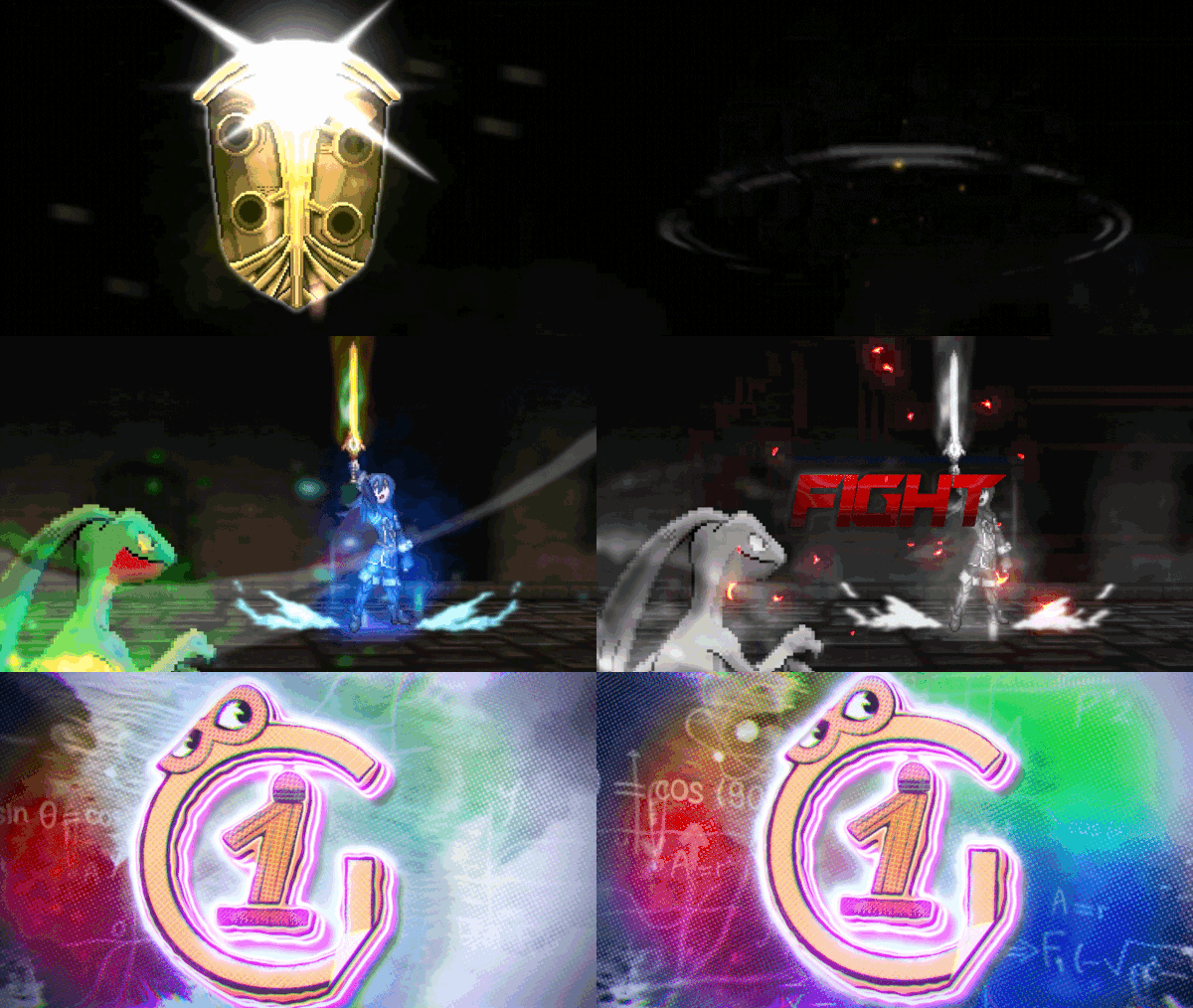
Credit to the amazing DeLite Animations for the animation!

Lucina, the Foreseer of Awakening from Fire Emblem.
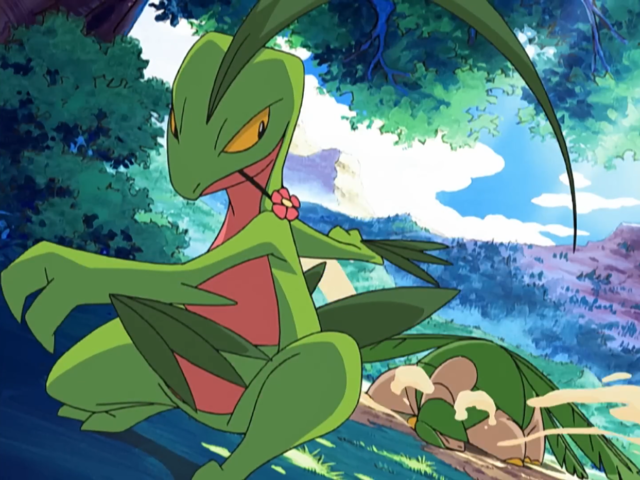
Grovyle, the Explorer of Time and Darkness from Pokémon Mystery Dungeon.
When the future lay in ruins and a dark dragon threatened the world’s end, these two chose to give up everything for the chance to change fate in the past. Even if they must be distant from everyone they love, or branded an outlaw, nothing would stop them with the fate of the world on their shoulders. Though it could only ever come through the bonds that they forged in the past that would light the way for a hopeful future. So when Ylisse’s Princess and Future Witness and the Time-Travelling Wood Gecko Pokémon face off in a DEATH BATTLE!, who will be the last standing saviour of the future?
Before We Start…
Fire Emblem is a massive franchise with several distinct continuities. For Lucina, our primary source of analysis will be Fire Emblem Awakening, and the games in direct continuity with it by extension. We have ultimately decided not to include any form of cross-scaling to Fire Emblem Heroes’ original feats in this blog.
However, she will be reasonably composited between other appearances she’s made in mainline games, provided they generally share the same background, abilities, and traits. This includes her appearances in the Future Past DLC, Fire Emblem Fates, and Fire Emblem Engage, as well as various tertiary media like manga adaptations and drama CDs. We’ll also include less canon things like Warriors and Cipher only insofar as they can be backed up by canon material without outright contradicting the source. Note that a large number of works such as books and a few games never made it overseas, so many fan translations were used. Primarily, we used the likes of FE Library for books and other assorted media, as well as assorted translations of some games and other media.
Please note that while we tried including some feats that should be safe to apply, we unfortunately cannot cover everything from the recent release of Fortune’s Weave (like legit, they also dropped a DLC trailer for it while we were working on it, god damn) just for how dense the game is. We may or may not cover the game as a whole in a future project, but for now, we hope you understand why we couldn’t possibly account for everything in this blog.
Our primary source for Grovyle will, of course, be the Explorers games, with the short manga and anime adaptations as secondary sources. Interestingly, Grovyle makes an appearance in Super Mystery Dungeon. Much like Lucina’s appearance in Engage, we believe that even if this Grovyle isn’t the same original, he does act the same, has the same general capabilities, and overall should be comparable enough to be composited.
As such, every Pokémon Mystery Dungeon game will be used for broader scaling in this analysis, not unlike the wide-reaching cross-continuity scaling provided to Lucina via Engage. We will not, however, be analyzing or including any feats or scaling to the core, mainline series of Pokémon games.
To be blunt, there are far too many critical differences in lore between the mainline and Mystery Dungeon games for them to be compatible in this manner. Dialga, who plays a large role in Explorers, for instance, is explicitly tied to Temporal Tower, whose structure and function does not exist at all in the mainline lore. This can’t be overlooked, as Dialga’s role in the mainline cosmology would fundamentally not work as presented in Mystery Dungeon. And this extends to many smaller cases spread throughout the series, like how Dusknoir’s soul-trapping powers in the mainline Pokédex require outside help in Mystery Dungeon.
In short, we’re primarily looking at both combatant’s games of origin and the surrounding continuities they’ve crossed over with directly. Broader-reaching cosmological implications from the Heroes mobile game and mainline Pokémon series are being left at the door as equally derivative factors in this fight that would fundamentally completely change the discussion. With all that out of the way, please enjoy the blog.
Lucina
The year is 2013. You wake up to the familiar sight of your childhood black-colored Wii console. Packing your bag for school, you slip in your Nintendo 3DS with a carrying case containing Pokémon Platinum, Black 2, and SoulSilver. You’ve poured a thousand hours across them, and thousands more to follow. But today, your mind isn’t on the creature-collector craze that has defined your life to that point. Today, you think only of an ad you saw between episodes of Regular Show and Adventure Time for a new game: Fire Emblem Awakening.
You’ve heard about it, of course. Where most people look at Marth and Ike in Super Smash Bros. with confusion, you’re quick to inform them of the niche series that only recently made landfall in the Western world. You know it, but you’ve never fully experienced it. And today, your curiosity gets the better of you. By the end of the day, your 3DS is loaded with the latest – and potentially final – entry in Fire Emblem.
Background
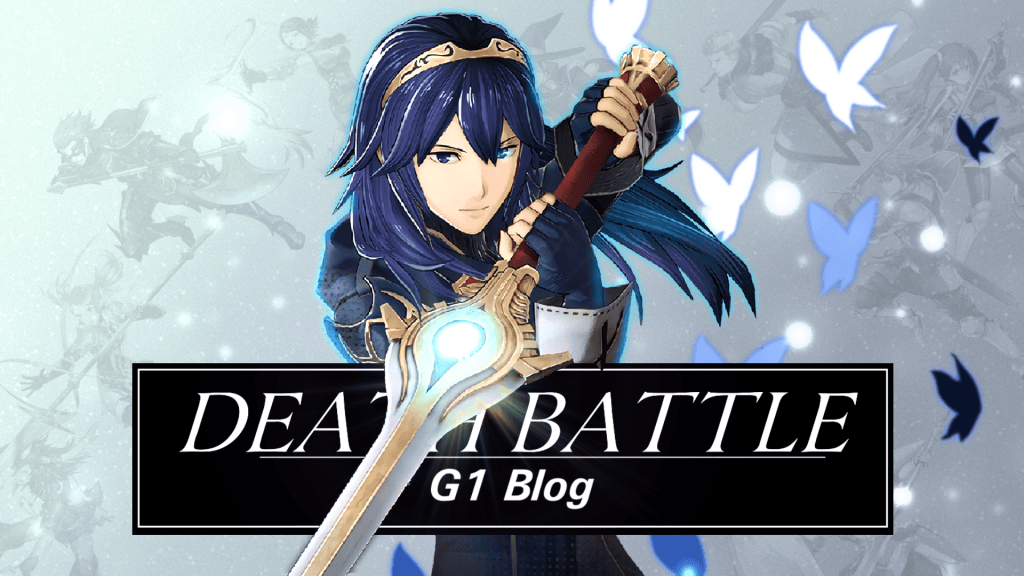
“Father… Mother… When all the fighting has ended, I hope you’ll rest easy wherever you are.”
- Age: Vaguely around 18-20ish
- Birthday: April 20th (Shared with Fire Emblem: Shadow Dragon and Fire Emblem: Path of Radiance)
- Titles: West-Khan Champion, Princess, Exalt of Ylisse
- Likes: Chrom, Robin, bear hats, cute clothes, Spider-Man
- Dislikes: Grima, flying bugs, using Falchion as a fruit cutter, Peppa Pig
- Cannot stress enough how horrible her fashion sense is
- Definitely does not have a part-time job at Hooters
In the south-east of the continent Ylisse lies the Halidom of… Ylisse, a kingdom with a long-standing history of heroics. Its ruler, the Exalt, descends directly from the Hero-King Marth’s bloodline, inheriting a legacy of protecting light from shadow. The current Exalt, Emmeryn, continued that noble mission until the Grimleal executed her – basically a doomsday cult. With the Exalt’s blood, the Grimleal began their work to revive the Fell Dragon Grima. Only Prince Chrom, now forced to fill his late sister’s shoes, could lead Ylisse’s armies against the forces of darkness. Chrom’s campaign against the Grimleal culminated in a final stand at the Dragon’s Table against their high priest Validar. Thanks to the faithful tactician Robin carrying the day, Chrom defeated Validar, putting an end to the nightmare that nearly enveloped the world. At long last, they could rest easy. Until the unthinkable happened. On the verge of restoring peace to the land, Robin’s magic struck Chrom’s heart, ending the young Exalt’s life. In truth, Robin’s lineage descended directly from the Fell Dragon itself; in a moment of weakness, their body became possessed by Grima, striking down Robin’s dearest ally with ruthless, cold efficiency. And now, there was no one left to stop Grima’s resurrection, none to oppose the unparalleled devastation the Fell Dragon would dispassionately invite upon the world.
Lucina inherited her father’s holy blade, the Falchion, and the world of troubles he left behind. As the Exalt’s daughter, Lucina grew up surrounded by her father’s former allies and their children, fighting every single day to protect other survivors and themselves from Grima’s undead berserker forces that infested the land. By the time she’d reached adulthood, Lucina and her friends’ small group of 12 formed the sole remaining force of Chrom’s Shepherd militia. Carrying their late parents’ hopes with them, the Shepherds set out to slay Grima by turbo-charging Lucina’s Falchion into a bona fide god-slayer. To do so, they needed to collect the five Gemstones to complete the ritual of Awakening, bathing Falchion and its wielder in divine flames to gain the power they needed to put Grima down for good. Their search was arduous and fraught with peril; in the end, they could only salvage four of the five stones. The Awakening ritual could not be performed. Even so, their failure was a necessary one, for in the depths of their despair, the Divine Dragon Naga offered them one final route to defeat Grima. Naga alone could send Lucina and her friends back in time to prevent Grima’s resurrection from ever transpiring in the first place.
Despite descending from the Hero-King himself, Lucina was hardly a fraction of the unwavering yet compassionate warrior she’d idolized since childhood. Lucina’s life had always been marked by the weight of her father’s sword, and the expectations she felt she could never live up to. As you can imagine, it’d be a lot for anyone to handle, but even more for the girl raised in an apocalyptic hellscape. Whether she liked it or not, she was the Exalt-to-be. She was the one others looked to for leadership and strength. In Lucina, others saw the splitting image of the Hero-King, but internally, there was only the scared little girl desperate to hold her parents’ hands. In order to be the leader her friends needed, to ensure the past could be changed, she’d need to deceive not just those present in her father’s time… but herself. Left with no other options in a dead world, Lucina adopted a mask and assumed the identity of Marth, stepping into the role of the legendary monarch for the strength to see her mission through. Together, Lucina and her friends faced the Divine Dragon’s Outrealm Gate and ran.
When Lucina awoke in the past, she found a world almost alien to her. Trees grew, flowers bloomed, and her father was, above all, alive. Even so, her mission demanded focus and restraint. In order to prevent Grima’s resurrection, she planned only to interfere in Emmeryn’s execution, refusing to tamper with time any more than necessary. To that end, Lucina – under the guise of Marth – trekked to Regna Ferox, where she’d defeat the reigning champion Lon’qu, ensuring her father wouldn’t sustain an injury in the fight he’d arrive for shortly after. Instead, Lucina crossed blades with Chrom herself, shocking her father with the sight of her Parallel Falchion.
As ‘Marth’, Lucina acted as a mysterious, enigmatic warrior with a knack for appearing at specific, dire moments. She saved her aunt Lissa’s life, granted Chrom the favor of Regna Ferox with her intentional defeat in their duel, and once more appeared when Emmeryn found herself surrounded by assassins. Tragically, it seemed, fate would not relent, even with Lucina’s best efforts. Emmeryn would still be captured, still be executed. Chrom would once more inherit his sister’s position as the Exalt, stamping out the Plegian King responsible for ordering her death. Years would pass, and Lucina would watch from the shadows, waiting. If she couldn’t save Emmeryn, the next and only choice she had was to kill her father’s trusted tactician, the person she knew was responsible for his death on the eve of their victory. She’d get her chance to join Chrom’s ranks as her father led a campaign against the Valmese Empire, using the position to more closely monitor threats to him. Eventually, the time came for her to confront her father’s killer face-to-face.
Wracked with the certain knowledge of the future that awaited the world should she fail to strike Robin down, Lucina… hesitated. In some worlds, Robin was her mother. In others, Robin was the man she loved dearly above all others. She’d seen everyone she loved in her life die, and she alone held the power to prevent those deaths if she could only muster the strength to take one more life. But she couldn’t. To Lucina, her lack of conviction proved she was a pale imitator of the Hero-King’s resolve. In truth, it was her compassion, mercy, and unwillingness to cut down even her own father’s betrayer that reflected Marth’s heart more brilliantly than any mask could ever mimic. Though Robin remained alive, Lucina would get the chance to tell her father the truth of her time travelling, finding the warmth in his embrace she’d been chasing all her life.
When the future seemed to proceed unaltered, Lucina reasonably panicked. But by allowing Robin to live, her father’s closest ally was able to do what they do best: strategize. With foreknowledge of what was to come, they used their ally Basilio’s certain death in Valm as a smokescreen. Instead of meeting his demise, Basilio feigned defeat, lying low until he was needed later. When Chrom and Robin once more defeated Validar under the shadow of the resurrected Grima, that simple deviation – Basilio’s death averted, a deception of the world’s predestined fate – gave way to something completely unprecedented.
Robin still pierced Chrom’s body with magic, but this time, the strength of their bonds gave them the will to hold back. Chrom survived the encounter, recouping with Lucina and the rest of the Shepherds. Together, they united as one against Grima, set to the backdrop of a city-sized dragon’s back and to the tune of one of the greatest final boss OSTs ever. Chrom defeated Grima, and Robin’s unique blood tie to the Fell Dragon allowed them to permanently end the agent of the apocalypse forevermore.
Some say that after Grima’s defeat, Lucina settled down with the love of her life, enjoying the peaceful future she’d helped create. Others claim she simply wished her newborn self a bright, happy future, before departing for lands unknown. Lucina’s deeds had become so renowned that the manifestation of her spirit would transcend her era. Her spirit was one of a select few that could be summoned during the War of Deliverance with the Divine Dragon Mila’s Turnwheel. Lucina’s spirit also manifested as one of the Emblems of Elyos. Her legacy would forevermore be cemented in history alongside the greatest heroes the Outrealms had ever seen; a true, uncontested equal to the Hero-King Marth she had always looked up to. How could she not be? For a single girl who dared to brave the currents of time and challenge fate itself, there could be no one more worthy of being called legendary.
Experience & Skill
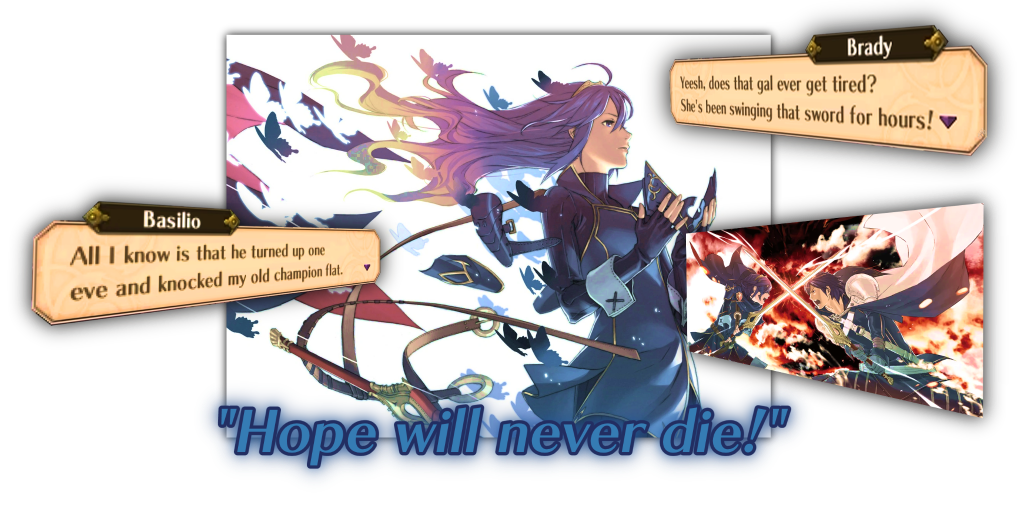
If there’s anything Lucina is known for, it’s her skill with a blade. She’s defeated Lon’qu (albeit offscreen), which is impressive since the Regna Ferox is a land of warriors and Lon’qu is considered their greatest swordsman, impressing even the West-Kahn Basilio himself. She’s kept up with Chrom, who is an acrobatic swordsman who can strike with powerful ferocity. It makes sense Chrom is her very own father who taught her that! Lucina once threw her sword, backflipped and killed an assassin in the time it took for them to arm their sword. She is likely familiar with Fire Emblem’s weapon triangle, which isn’t just a gameplay thing, thus knows that swords beat axes, axes beat lances and lances beat swords. She can defeat and keep up with the Deadlords summoned by Aversa who were great warriors in life.
While Lucina isn’t invincible, she can train for hours without rest and weirdly enough knows submission grapples. She’s kept up with Ike’s Einherjar (which is explicitly described as a mirror image of who the person was), who is considered a master swordsman, accomplishes everything he sets out to do and is a true hero. Aside from that, while Lucina is obviously skilled with a blade (especially as a Swordmaster, who’s considered reaching the pinnacle of swordsmanship), at her peak, she’s mastered all of her possible classes in Awakening. The main one is of course a Great Lord who is a mighty royal who can command armies. If her mother was Robin, she can also become a Grandmaster tactician with exceptional command ability and a pivotal unit in any army. Even without that though, she can master the Falcon Knight class who control their pegasus with great mastery and a Sniper who wields such precision that they mastered the bow. We’d be here all day listing all of them, but it’s clear that aside from swords, Lucina can master all sorts of different classes that can use lances, axes, bows, healing staves and magic tomes, giving her a huge variety of powers to pull from.
Perhaps the most impressive thing about Lucina is everything she’s been through throughout her experience in Awakening. She was one of the few survivors in her time, leading the army when her father Chrom passed away. She travelled back in time Future Trunks-style to save the past and helped defeat formidable enemies like Walhart, Aversa and Validar. She was even prepared to kill Robin to prevent the tragedy in the future from happening (though thankfully that did not need to happen). She helps Chrom and Robin defeat Grima by the end of Awakening’s adventures. In an alternative future though known as Future Past, she’s the one that’s able to lead the second generation to defeat Grima herself and help bring peace back to Ylisse, just like her father before her. Hope will never die so long as Lucina still breathes.
Equipment
Note that while most Fire Emblem characters have a limited amount of items they can have on their person at once, there are specific exceptions to this rule. In particular, Lords (or main characters, basically) have access to the Convoy, where all items acquired are stored. With the Convoy, Lucina can draw upon any item she could possibly ever have without being limited by the usual weapon/item slot restrictions. We should also note that this particular exception stems from her appearance in Future Past, where she is the central lead character, which we’ve included in this analysis per the introductory guidelines.
Parallel Falchion
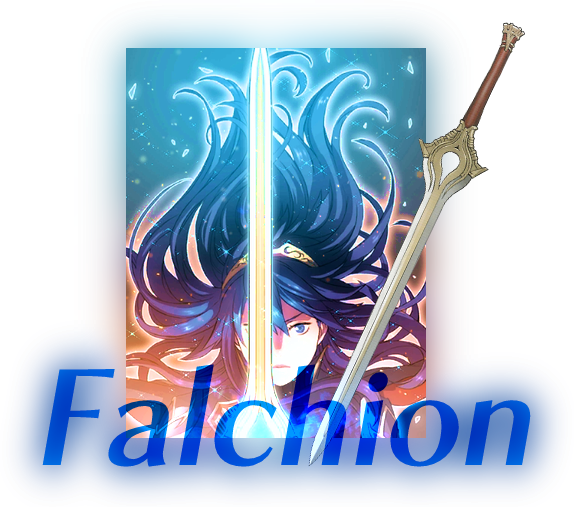
“When all else is lost, the future still remains”
One of Ylisse’s national treasures and Lucina’s last gift from her father. Forged in Ylisse’s ancient past when dragons ruled the continent, its blade is forged from one of Naga’s own fangs and given to humanity to be the fang they never had. The sword is selective in who can even wield it; even Ylisse’s own royal bloodline can’t universally wield it without an enormous loss in cutting power. Despite not being in its fully Exalted state in the main game, lacking the capacity to seal dragons, it still shares the Divine Dragon tribes’ trait of being far deadlier against draconic foes, manifesting as dealing bonus damage to wyverns and dragons. It can also be used in battles like an item, being able to restore HP upon use. Unlike most weapons, it does not have durability and cannot break with prolonged usage
After performing the Awakening, Lucina unlocked the full power of the now Exalted Falchion. In this state, the Exalted Falchion possesses the ability to seal dragons away for thousands of years, and retains its self-healing capabilities. As the blade is at its peak potential, it should likely regain abilities it once had under Marth’s ownership, and compare to other Falchions made by Naga, such as Alm’s. Their blades, respectively, have the power to kill gods such as Duma. Interestingly, when using the Exalted Falchion, the Divine Dragon (this time, Tiki) states that the blade will “wipe the Fell Dragon from existence.”
Fire Emblem
(Binding Shield)
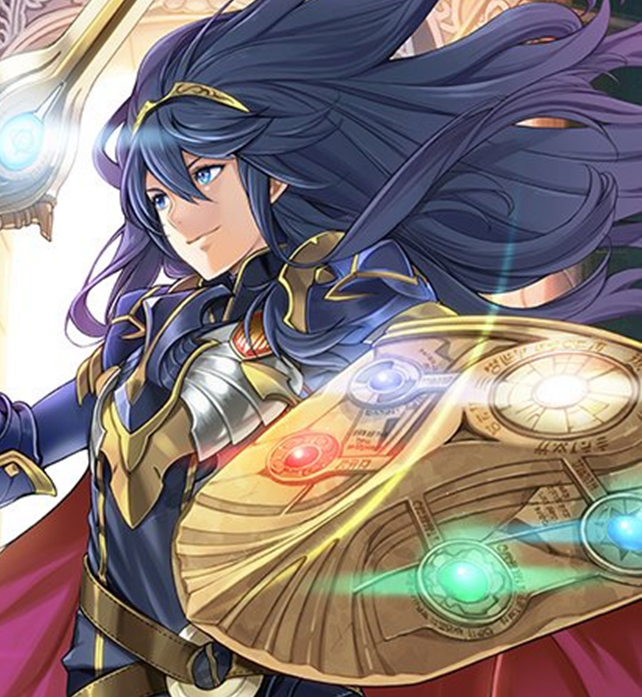
A shield fit for an Exalt, the Binding Shield contains five powerful gemstones that grant the shield special capabilities. For instance, simply having the shield in ones’ possession can dispel illusions, and it somehow works as a universal treasure chest key. Aside from that, the Binding Shield has the ability to seal away foes such as Earth Dragons, making it a perfect match for Falchion, which can do similar.
Gemstones

In order to complete the Binding Shield, five gemstones are necessary to activate its full power. When Marth was in the process of filling out the shield, he demonstrated the use of the stones individually. Technically, there should be no reason Lucina couldn’t do the same, as she, too, possesses the Binding Shield and by proxy, all of the gemstones. Still, she has never done so in any canon, so your mileage here will vary.
When Chrom assembled the Binding Shield himself, he could still feel the power of a Gemstone flowing within him, and obviously, can still power up the Falchion, so there’s not much reason to assume they’re drastically weaker than when Marth used them.
- Argent
- Also known as the Lightsphere. Those in possession of the Lightsphere are immune to mind-controlling effects, seeing as how it is the counter to the Darksphere. Additionally, it prevents foes from making critical hits.
- Azure
- Also known as the Starsphere. Makes the wielder’s weapons unbreakable and gives small boosts to stats in combat.
- Vert
- Also known as the Geosphere. Can induce earthquakes throughout an entire battlefield, damaging everyone within.
- Gules
- Also known as the Lifesphere. This incredible artifact fully heals the wielder with no limit to the number of instances, and it does so automatically.
- Sable
- Also known as the Darksphere. This orb can directly possess an opponent’s mind, corrupting them entirely and preventing them from raising their hand against the wielder. Marth’s ally, Hardin, is notable for being a victim of the Darksphere’s influence, turning him into a villainous tyrant almost immediately upon coming into contact with the sphere.
Miscellaneous Weaponry
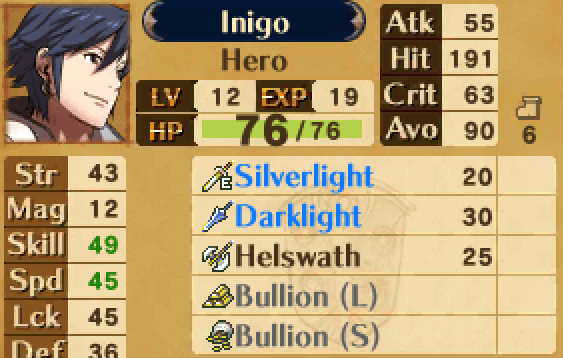
Lucina may be best known as a swordfighter, but modern Fire Emblem titles rarely restrict its cast to a linear set of weapons. At her maximum potential, Lucina can master every weapon type in the games she appears in (with the exception of Dragonstones), so we’ll allow her access to every weapon she could theoretically have in her arsenal.
Furthermore, these weapons are taken not only from Awakening, but her appearances as a playable character in Fates and Engage as well. She specifically has access to the Dread Fighter class in Fates, which allows her access to unique daggers and shurikens not found in her home game.
Lists for every weapon in Awakening, Fates and Engage are attached in those links.
Swords
- All weapon categories regularly come in Bronze, Iron, Steel and Silver varieties. Bronze weapons have 50 uses before breaking but with low power, escalating to Silver Weapons which have 30 uses before breaking but have high attack power
- Glass Weapons tend to only have 3 uses, but have among the higher levels of attack power
- Superior Weapons grant a massive increase to hit and avoid rates against enemies with the same type of weapon (i.e. Sword vs Sword)
- Brave weapons are lightweight and allow the user to attack twice before the opponent can, with 30 uses
- There’s also joke weapons that are terrible in all stats that won’t be brought up
- Rapier & Noble Rapier – A pair of Lord exclusive weapons, they both share the trait of dealing bonus damage to armoured and mounted opponents. Noble Rapiers are stronger, but have less uses (35 uses for regular, 25 uses for Noble)
- Armorslayer – Deals bonus damage to armoured units. 25 uses
- Wyrmslayer – Deals bonus damage to dragons. 30 uses
- Killing Edge – Has a higher rate of performing critical hits. 30 uses
- Levin Sword – Ranged, magic sword that attacks with lightning. 25 uses
- Soothing Sword – Restores 10 HP per turn when equipped. 10 uses
- Sol – Grants the Sol skill when equipped, giving a chance to restore 50% of damage dealt as HP if triggered (More in Stats explanation). 30 uses
- Amatsu – Sword that can be thrown as a ranged weapon. Only usable by Myrmidons and Swordmasters. 30 uses
- Leif’s Blade – Enemies have a chance to drop Gold when defeated. 20 uses
- Roy’s Blade – No notable characteristics. 25 uses
- Eliwood’s Blade – No notable characteristics. 20 uses
- Alm’s Blade – High might. 10 uses
- Eirika’s Blade – Acts the same as a Brave Sword. 20 uses
- Seliph’s Blade – Grants +2 to Speed and Resistance when equipped. 15 uses
- Mercurius – One of the 3 Archanean Regalia, it boasts among the highest might of all usable swords. 25 uses
- Tyrfing – +5 Resistance when equipped. 25 uses
- Balmung – +5 Skill when equipped. 25 uses
- Mystletainn – +5 Speed when equipped. 25 uses
- Sol Katti – +5 Resistance when equipped, only usable by Myrmidons and Swordmaster. 25 uses
- Ragnell – +5 Defense when equipped, also a ranged weapon. 25 uses
Lances
- Javelin, Short Spear, Spear – Throwing weapons, with different levels of power. All have 25 uses
- Beast Killer – Deals bonus damage to mounted and beast units such as cavaliers, pegasus knights and taguels. 25 uses
- Killer Lance – Increases critical hit chance. 30 uses
- Blessed Lance – Deals bonus damage to monsters, restores 10 HP per turn. 35 uses
- Miniature Lance – Weak, but has an extremely high critical hit rate. 10 uses
- Shockstick – The lance equivalent of a Levin Sword. 20 uses
- Luna – Grants the Luna skill, giving a chance to halve enemy defense when attacking if triggered. 30 uses
- Sigurd’s Lance – High might, 15 uses
- Gradivus – Another of Archanea’s 3 Regalia, it can be used as an item to fully restore HP. Also usable as a ranged attack. 25 uses
- Ephraim’s Lance – +2 Strength and Speed when equipped. 20 uses
- Finn’s Lance – +2 Luck and Defense when equipped. 25 uses
- Gae Bolg – +5 Defense when equipped. 25 uses
- Gungnir – +5 Strength when equipped. 25 uses
Axes
- Hand Axe, Short Axe, Tomahawk – Throwing weapons with varying levels of power. All have 25 uses
- Volant Axe – Throwing axe that deals more damage to flying units. 10 uses
- Hammer – Deals bonus damage to armoured units. 25 uses
- Killer Axe – Higher chance of a critical hit. 30 uses
- Bolt Axe – The axe equivalent of the Levin Sword. 30 uses
- Imposing Axe – Low chance to hit, but strong attack power. 10 uses
- Vengeance – Grants the Vengeance skill when equipped, adding half of lost HP as bonus damage if triggered. 30 uses
- Titania’s Axe – Grants the Patience skill when equipped, granting +10 Hit and Avoid if an enemy initiates combat. 20 uses
- Orsin’s Hatchet – Ranged weapon. 20 uses
- Hector’s Axe – +2 Strength and Defense when equipped. 15 uses
- Armads – +5 Defense when equipped. 25 uses
- Helswath – +5 Defense when equipped. Also a ranged weapon. 25 uses
- Hauteclere – Can be used as an item to restore all HP. 25 uses
Bows
- Blessed Bow – Deals bonus damage to monsters, restores 10 HP per turn. 35 uses
- Killer Bow – Increases critical hit chance. 30 uses
- Longbow/Towering Bow – Unlike most bows, can hit from 3 tiles away rather than just 2. Only usable by Archers and Snipers. 25 and 10 uses respectively
- Astra – Grants the Astra skill when equipped, attacking 5 times in a row at half damage if triggered. 30 uses
- Underdog Bow – Grants the Underdog skill when equipped, giving +15 Hit and Avoid if an opponent’s level is higher. 15 uses
- Wolt’s Bow – Can be used as an item to restore 20 HP. 25 uses
- Innes’ Bow – Incredibly high accuracy. 15 uses
- Parthia – One of the 3 Archanean Regalia. Grants +5 resistance when used as an item, decreasing by 1 each turn. 25 uses
- Nidhogg – +10 Luck when equipped. 25 uses
- Yewfelle – +5 Speed when equipped. 25 uses
- Double Bow – +5 Strength when equipped. 2-3 tile range, only usable by Archers and Snipers. 25 uses
Magic
Magic, while exclusive to certain classes, is performed by ambient natural energies to manipulate the world’s elements for attacks. They also require resistance rather than physical durability to defend against.
- The magic categories in Awakening are Fire, Lightning and Wind. Other categories such as Light magic is present in the series, but absent in game.
- Like physical weaponry, generic tomes come in base, El-, Arc-, and special named versions (ex. Fire, Elfire, Arcfire and Bolganone), having the same characteristics of higher damage but less uses with stronger versions. Strongest lightning and wind magic is Thoron and Rexcalibur
- Like bows, all Wind magic innately deals more damage to flying targets
Fire Magic:
- Dying Blaze – High might, but only 3 uses
- Micaiah’s Pyre – +2 Defense and Resistance when equipped. 15 uses
- Valflame – +5 magic when equipped. 25 uses
Lightning Magic:
- Superior Jolt – +50 hit and avoid when the opponent uses magic. 10 uses
- Katarina’s Bolt – Has a high critical hit rate. 20 uses
- Mjolnir – +5 skill when equipped and generally good crit rate. 25 uses
Wind Magic:
- Wilderwind – Low might and only 5 uses, but very high critical hit rate
- Excalibur – Strongest Wind magic with comparable crit rate to Killer weaponry. 25 uses
- Celica’s Gale – Functions like Brave Weaponry, 20 uses
- Forseti – Wind magic, +5 speed when equipped. 25 uses
Book of Naga – Uniquely uncategorized magic, but +5 defense and resistance when equipped and deals bonus damage to dragons. 25 uses
Dark Magic
- Flux – Basic Dark Magic spell. 45 uses
- Nosferatu – Recovers HP equal to half the damage dealt to the enemy. 20 uses
- Ruin – Has a 50% chance to land a critical hit. 20 uses
- Mire – Unit is unable to double attack, but can strike from 3-10 spaces away. 10 uses
- Waste – Allows units to attack twice as many times, like a Brave weapon. 30 uses
- Aversa’s Night – Recovers HP equal to half the damage dealt to the enemy. 10 uses
- Goetia – Possesses the highest base Might of all Tomes in Awakening. 25 uses
Staves
- Recover – Fully heals the target.
- Rescue – Can teleport the target across the battlefield
- Ward – Increases the target’s resistance to magic by a fair amount
- Hammerne – Can be used to repair damaged weapons
Daggers / Shurikens
- Spy’s Shuriken – An extra long range, lightweight projectile. Ideal for sniping foes from afar, debuffing their stats safely before moving in for the kill.
- Flame Shuriken – A magical shuriken that deals, you guessed it, magic damage.
- Fruit Knife – Can heal the user
- Kris Knife – Effective against monsters and heals the user passively over time
- Stale Bread – Yet another weapon that heals the user after initiating combat
- Votive Candle – If Lucina is at all above 1HP, gives her a chance to withstand any lethal attack.
Consumable Items
- Sweet Tincture, Vulnerary, Concoction, Elixir – Restores 5, 10, 20 HP. Elixirs fully restore all HP no matter what. Regular Vulneraries in the story can heal gaping wounds and arrow injuries. 3 uses
- Pure Water – Increases Resistance by 5. Decreases by 1 every turn, 3 uses
- Tonics – Tonic come in different varieties for every single stat, increasing them all by 2 (5 for HP) for a battle’s duration. 1 use
- Kris’s Confect – +5 max HP and +2 Defense and resistance for one battle. 1 use
- Gaius’ Confect – +2 Strength, Speed, and skill for one battle. 1 use
- Tiki’s Tear – +5 HP and +2 to all stats for one battle. 1 use
- Master Seal – Promotes a base class to an advanced class, 1 use
- Second Seal – Reclasses the unit, 1 use
- Wedding Bouquet – Reclasses to the Bride class
- Reeking Box – Can summon the Risen onto the battlefield.
- Rift Door – Summons one of the many Annas from the Outrealms onto the battlefield.
Abilities
Stats Explanation
- HP – Hit points, dies upon reaching 0. Universal cap is 80 HP
- Strength – Affects damage with physical weapons
- Magic – Affects damage with magic weapons
- Speed – Speed of the unit. Affects ability to avoid attacks, and can do follow up attacks if there is enough of a difference (5 greater speed in gameplay)
- Skill – Affects hit rates, critical hit rates, and used as a determining factor for offensive skill activations, using the stat as a percentage (i.e (Skill)% with a stat of 30 would mean a 30% activation rate)
- Luck – Minor affect on hit rates, lowers enemy critical hit chances, and used for defensive skill activation rates
- Defense – Defense against physical attacks
- Resistance – Defense against magic attacks
- While not directly stats, Hit is the units ability to hit an enemy, Avoid determines chances of dodging, Critical determines chances of a critical hit and Critical Avoid determines chances of an opponent not scoring a critical
Skills
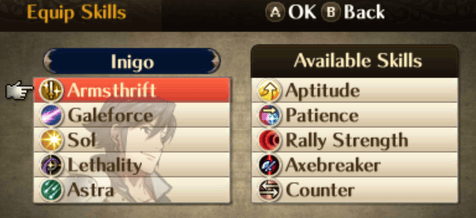
At her maximum potential, Lucina would have gained all sorts of powerful skills from mastering other classes. We won’t list literally everything to avoid bloat (I mean, do we need to list the ones that give +5 HP?) but we’ll at least take into account the most notable ones. You can find a full list of the skills available to her in Awakening, Fates, and Warriors here.
- Aether – A two hit attack. The first hit consists of the ability Sol, which heals the user for half the damage dealt to the opponent. The second consists of Luna, which treats the target’s defense or resistance as half depending on if a magic weapon is used
- Rightful King – All skills that have a percent based chance of activating, such as Aether, Sol, Luna and Astra have a permanently boosted rate of activation
- Outdoor Fighter – Increases accuracy and evasion when fighting outside
- Aegis – Halves damage from bows, magic, and dragon’s breath attacks.
- Luna – Halves enemies defenses when dealing damage
- Prescience – Increases evasion and accuracy when initiating combat
- +20 Hit – Increases accuracy
- Bowfaire – Increases damage output when using bows
- Bowbreaker – Greatly increases evasion and accuracy if opponent uses a bow
- Ignis – Adds half of the user’s Magic stat to Strength when using a physical attack, and vice versa when activated
- Indoor Fighter – Increases accuracy and evasion when fighting inside
- Pavise – Halves all damage from swords, axes, lances, and beast weapons
- Avo. +10 – Increases evasion
- Vantage – Will always attack first if HP is below 50%
- Astra – Hits 5 times at half damage in rapid, unbroken succession. In some games, acts as a permanent movement and attack speed boost
- Swordfaire – Increases damage output when using swords
- Lethality – An attack that lands on the opponent will kill instantly if skill is activated
- Pass – Unit can move through spaces occupied by an enemy
- Armsthrift – Attacks do not use weapon durability if triggered
- Patience – Increases accuracy and evasion if enemy initiates combat
- Sol – Restores 50% of damage dealt as HP if triggered
- Axebreaker – Greatly increases accuracy and evasion if opponent uses an Axe
- Lucky Seven – Increases accuracy and evasion early on in a fight
- Acrobat – Unit suffers no movement penalties from terrain
- Focus – Increases critical hit rate
- Tomefaire – Increases damage output when using a tome
- Slow Burn – Increases accuracy and evasion every turn
- Lifetaker – After attacking, restores 50% of HP if the enemy is defeated
- Hex – Adjacent foes suffer a debuff to their evasion
- Anathema – Lowers enemy accuracy and evasion by being in Lucina’s proximity
- Vengeance – Adds half of missing HP as damage when activated
- Tomebreaker – Increases accuracy and evasion if opponent uses a tome
- Relief – Restores 20% of HP passively per turn
- Lancefaire – Greatly increases damage output when using a lance
- Galeforce – If initiating combat, the user can act again if they defeat an enemy. Usable once per turn. Particularly useful for cracking the game’s entire meta like an egg
- Tantivity – Increases accuracy and evasion
- Quick Burn – Increases accuracy and evasion, decreasing in value a bit over time
- Swordbreaker – Increases accuracy and evasion if opponent uses a Sword
- Lancebreaker – Increases accuracy and evasion if opponent uses a Lance
- Miracle – If the user has 2 or more HP, survives a lethal attack with 1 HP if activated. This works no matter the gap in stats between the user and opponent, and activates automatically, not consciously
- Healtouch – Restores extra HP with staves
- Renewal – Passively restores 30% at the start of every turn
- Warp – Allows those who have mastered the Witch class in Fates to teleport freely across the map
DLC Skills:
- Iote’s Shield: Negates bonus damage towards flying units
- Limit Breaker: Adds +10 to stat caps
Lunatic+ Skills: Yep, Lucina has access to these because during her time as a boss in Awakening (and if you’re crazy enough to do this difficulty), she can gain some very powerful skills that’ll tip the scales in her favor, including:
- Vantage+: Will let Lucina strike first, even when attacked on the enemy’s turn. No health drop needed.
- Luna+: Always activating no matter what, Lucina can ignore half of her foe’s defense to inflict some incredible damage.
- Pavise+: Now always activating instead of by chance, attacks from swords, lances, axes, monster weapons and beaststones are cut in half.
- Aegis+: Basically the range variant of Pavise, it’ll cut damage from bows, tomes (magic), and dragonstones in half.
- Hawkeye: Attacks are guaranteed to hit.
Awakening Mode
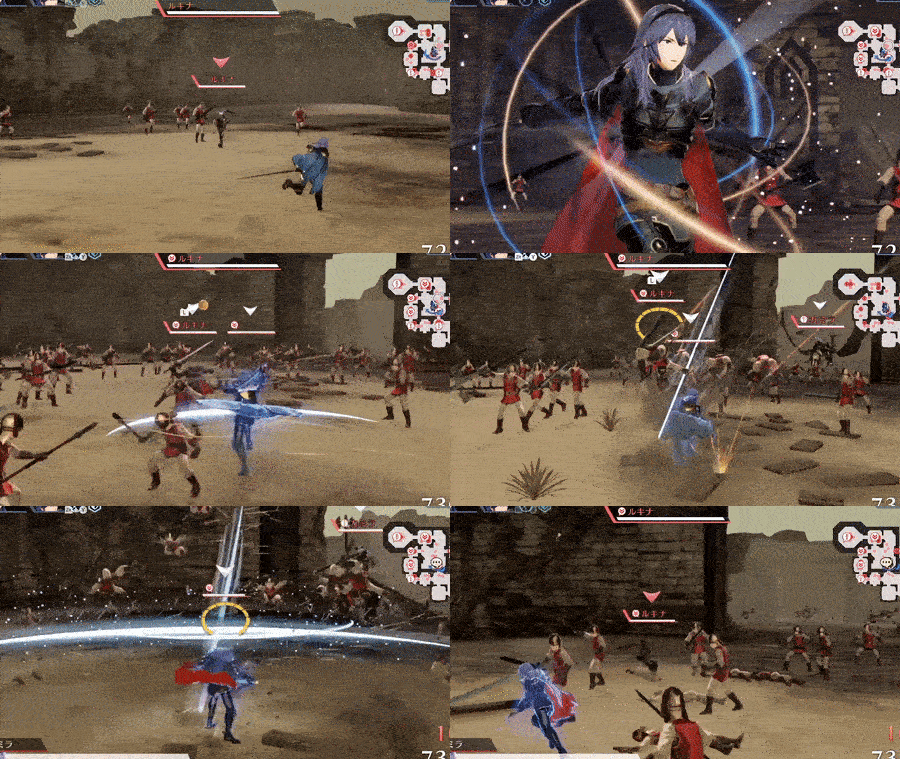
Essentially a super-mode Lucina can tap into, increasing her attack speed and power. Additionally, she gains an advantage against all weapon types, allowing her to break defensive gauges and deal critical blows much more reliably. Once the mode depletes entirely, she unleashes her most powerful special attack.
Acrobatics
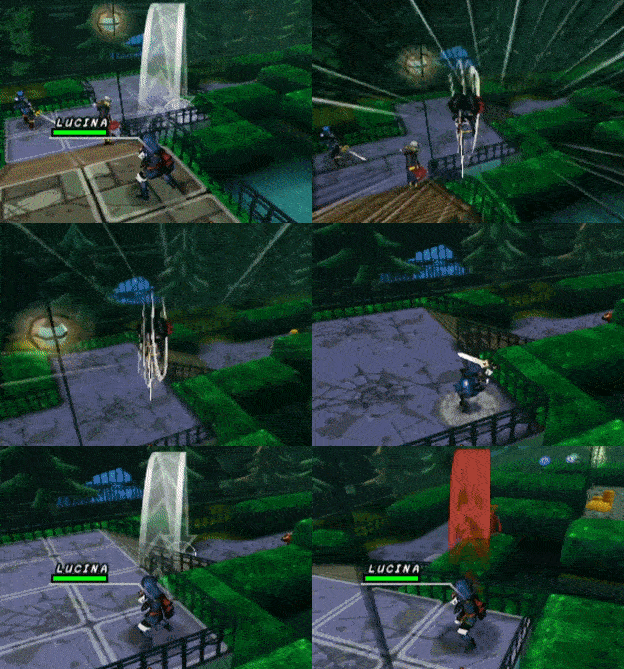
Not exactly a power, sure, but it’s weirdly consistent how acrobatic Chrom and Lucina are in battle. Both have been shown to be capable of leaping extremely highly into the air, somehow performing a spin in the process. In Lucina’s case, she utilizes this agility to traverse battlefields, leaping into advantageous positions in a matter of seconds. Look at her go!
Weapon Conjuration
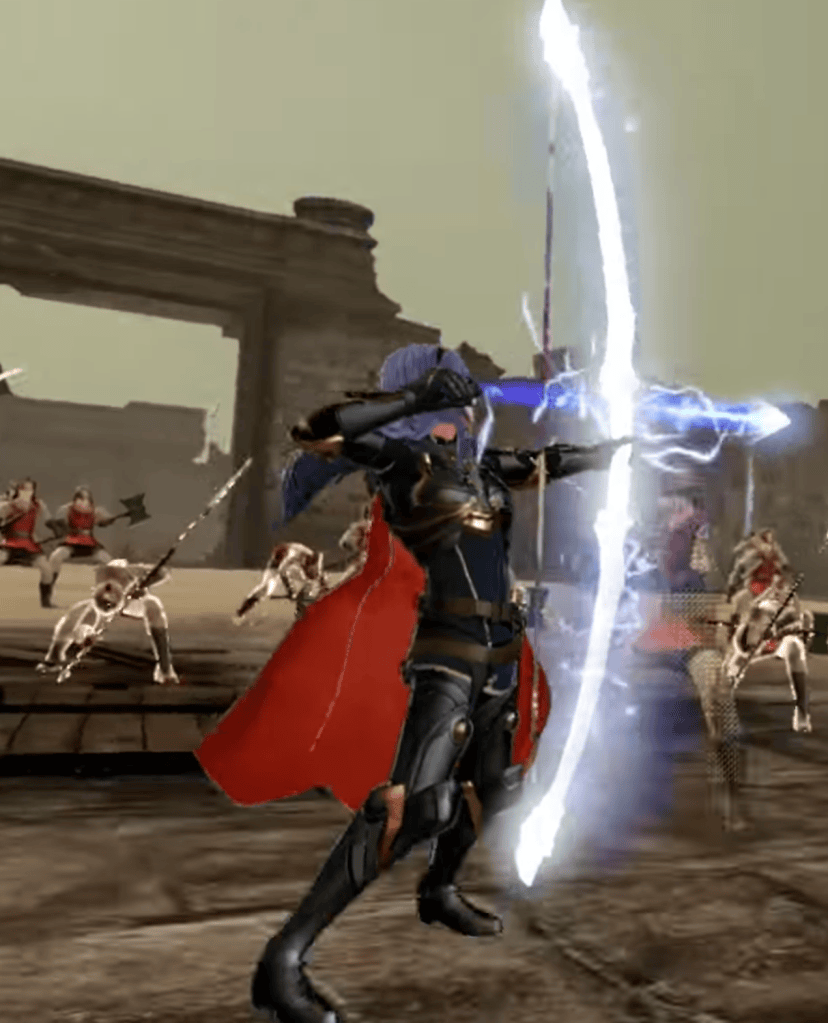
Aside from her physical weapons, Lucina can also conjure a bow made of some kind of light energy for use in battle. The arrows seem to be imbued or made entirely out of electricity.
Electricity Infusion
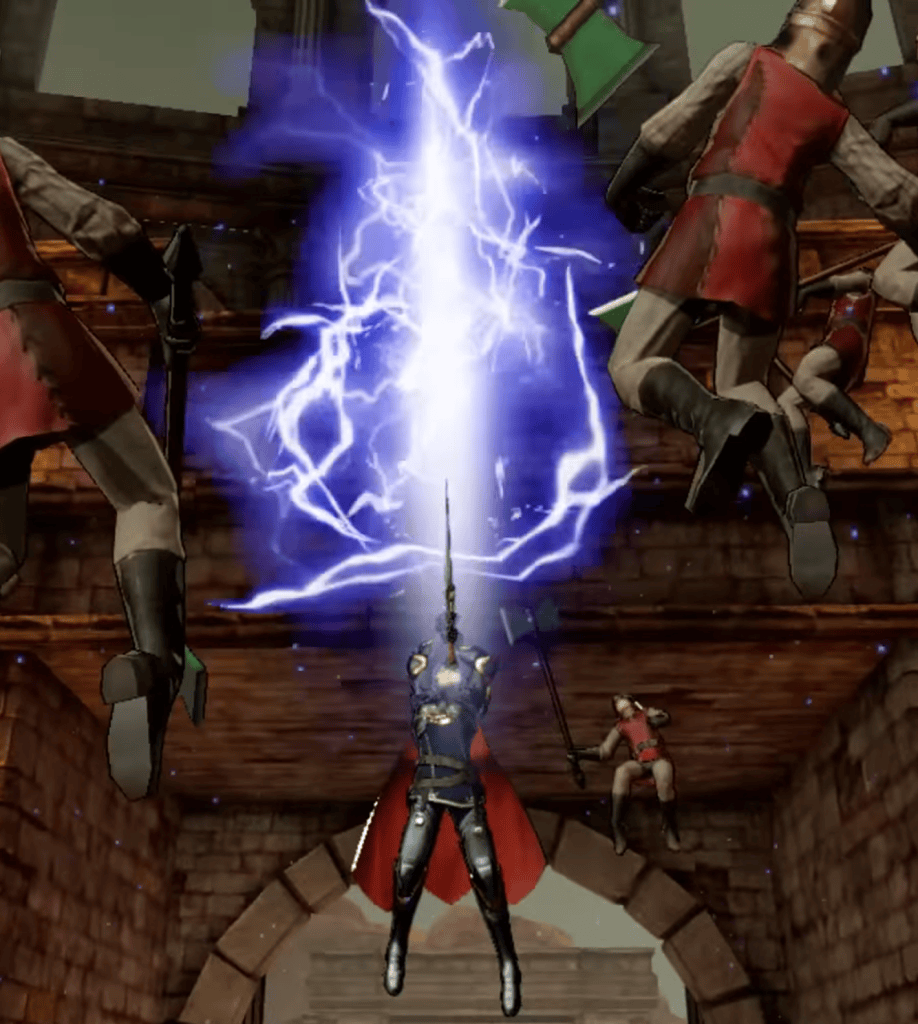
When showing off her full might, Lucina has shown the ability to imbue her swords with vicious electricity.
Sealing
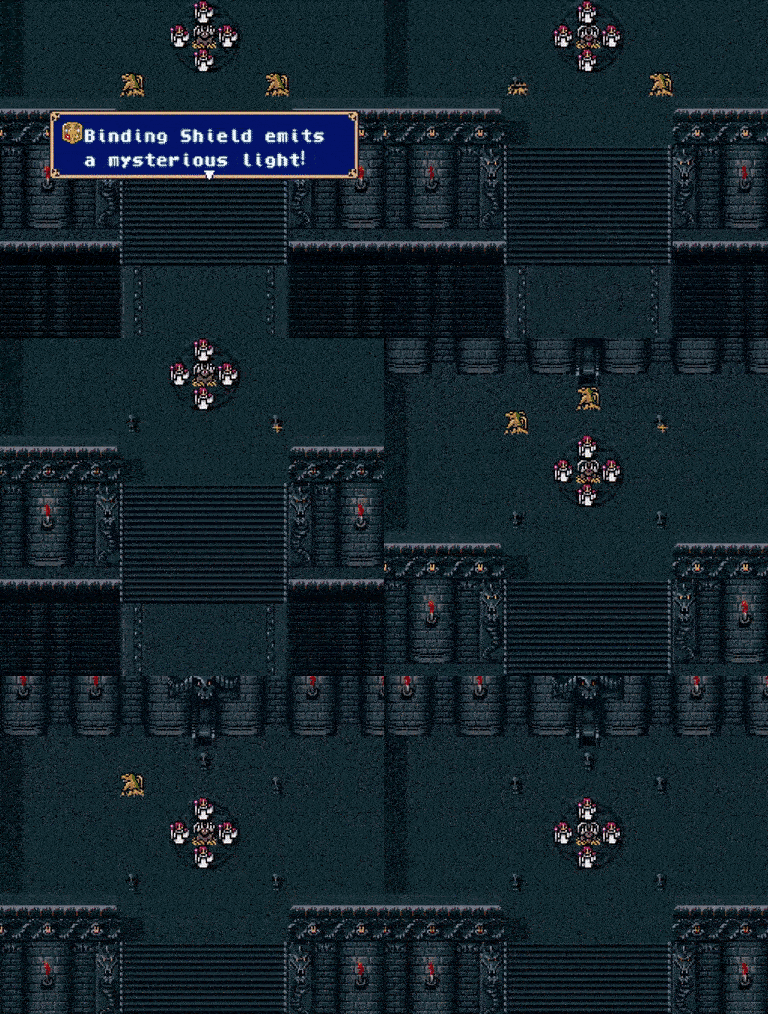
Aside from simply slaying dragons, Falchion and the Binding Shield possess the ability to seal them away. On multiple occasions, it’s been shown and said that those sealed by Falchion are put into a deep slumber. However, when Chrom seals Grima (including Robin’s physical body) away, he seemingly disperses or transports Grima’s human vessel… somewhere. When the Binding Shield seals its’ targets, we at least see them get sucked into the ground, so that much is clear.
Power Nullification
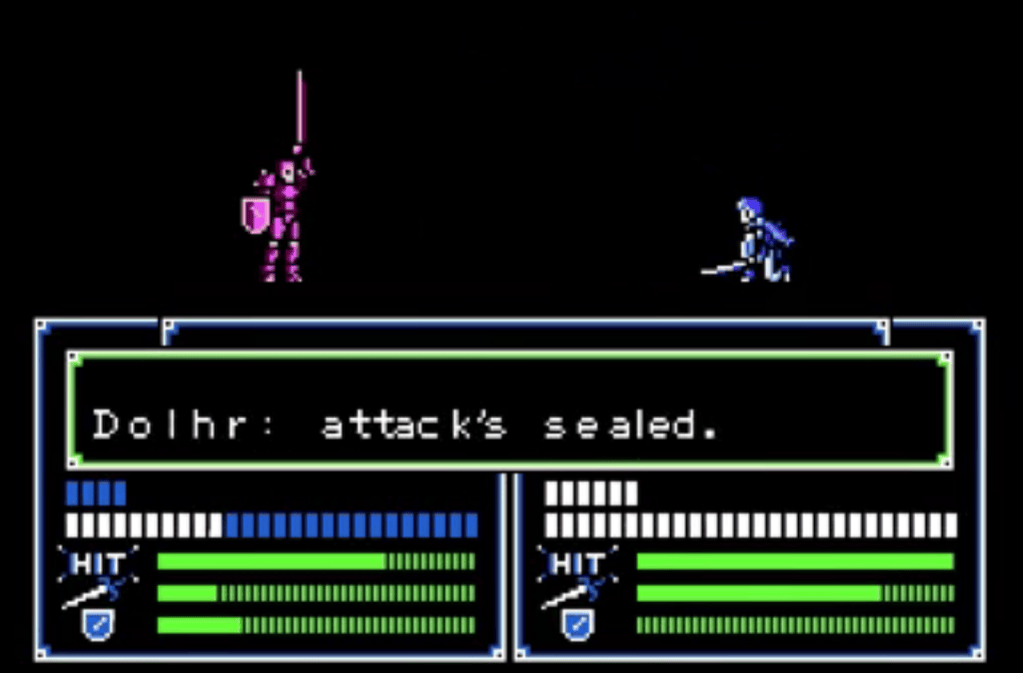
Most notably demonstrated when Emperor Rudolf, wielding the Valentian Falchion, sealed away Mila’s powers, according to one of Mila’s attendants. Marth’s Falchion also showed the ability to nullify attacks from ordinary foes, with the only exceptions being magic.
Teleportation
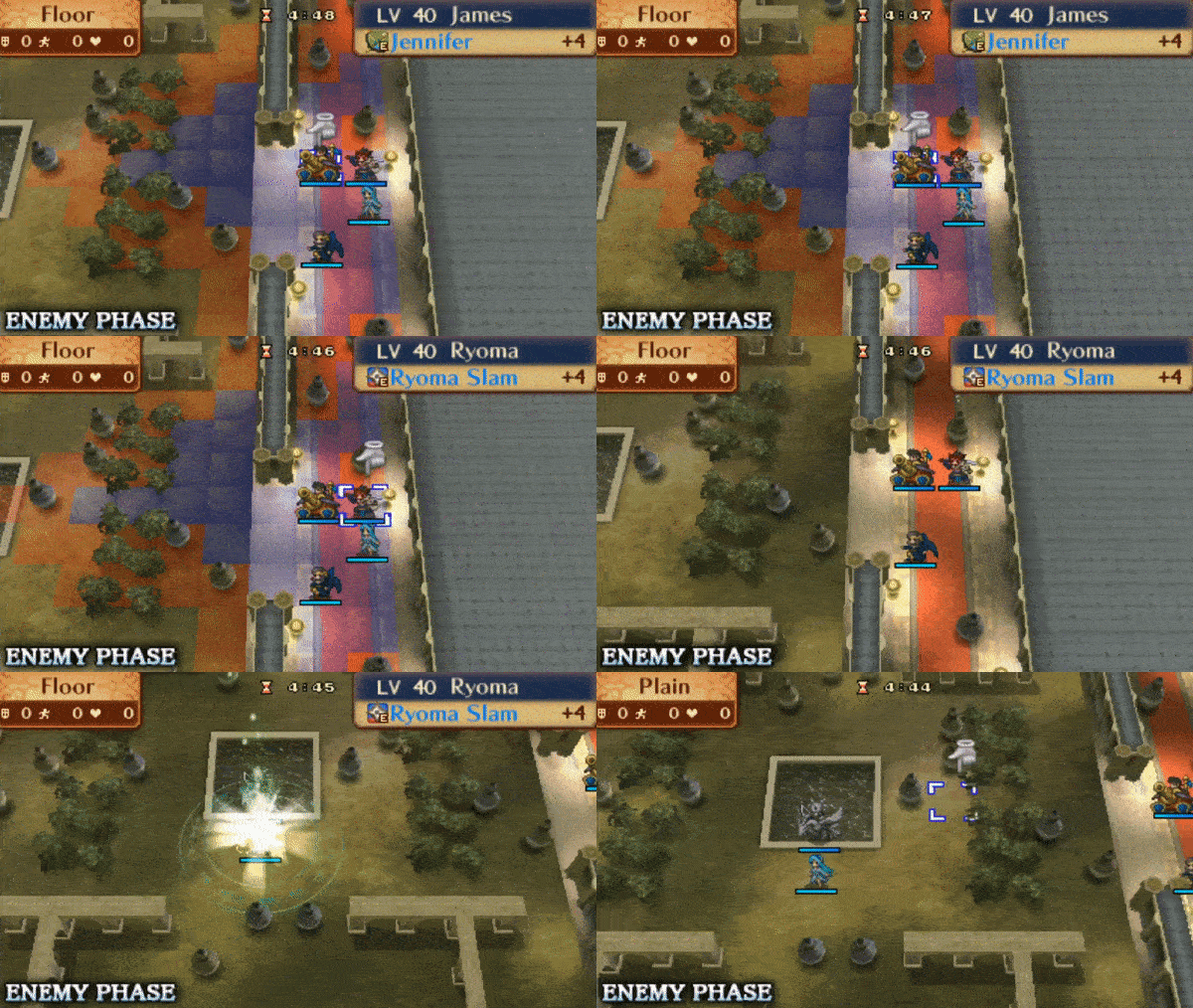
By using an item dropped by a Witch, or simply reclassing into one herself, Lucina can equip the Warp skill, which allows her to teleport across entire battlefields in an instant.
Non-Physical Interaction

In the Archanea saga and related Fateslandia arcs, every character has the ability to fight spirits such as Gharnef in the former case, and Vallite soldiers in the latter. Technically, the Vallites aren’t confirmed to be ghosts or spirits or anything, but they do materialize out of thin air and are usually invisible. Contextually, many of the characters depicted this way have canonically died, such as Makoto, Scarlet, and Arete, so it’s not far-fetched to believe they’re spirits.
If you really wanna go further, characters like Seliph can perceive and respond to his dead parents’ spirits. Obviously, Seliph doesn’t fight his parents when he sees them, but the fact that he, well, sees them at all is good supporting evidence.
Lastly, in Future Past, we actually see yet another similar case of Tiki becoming a spirit after her physical death at the hands of Grima. This is interesting, because Tiki only becomes the new ‘Naga’ after Grima also kills, well, Naga. If we’re to assume Tiki as a spirit is comparable to how Naga was, it could be construed that Grima killed Naga’s spirit, and then you could relate that to Lucina for being comparable to Grima and Naga with the Exalted Falchion.
Resistances
- Magic: There’s a literal stat called Resistance that Lucina raised to the max to lower damage from magical attacks. It’s directly referenced as a canonical ability too! This is even stronger with the Aegis ability that can directly half damage from tomes.
- Transmutation: While somewhat roundabout, Lucina is comparable in power to Priam. As a descendant of Ike (regardless of if it’s through Ike or Mist’s direct lineage), Priam should retain the ability demonstrated by the Greil Mercenaries to resist Ashera’s stone transmutation. This resistance is specifically attributed to Ike & co. simply being stronger than the weaker Beorc (which are stand-ins for humans of course) soldiers and Laguz, who succumbed to Ashera’s judgement, rather than being a specific ability of theirs or an exception on the goddess’ part.
- Also, Yune could not have done anything because she had not blessed anyone yet as she had just woken up.
Classes
While Lucina doesn’t have any traditional forms like a Super Saiyan or Devil Trigger, she can change to different classes in Awakening to give her different abilities and access different weapons. We’ll mainly list the main promoted classes just so the list doesn’t get too long. Should be noted there are some classes she can’t access depending on who her mother is… except for if it’s Robin, in which case that lets her access every female class, so we’ll take that into account so she can fight at her best.
Great Lord
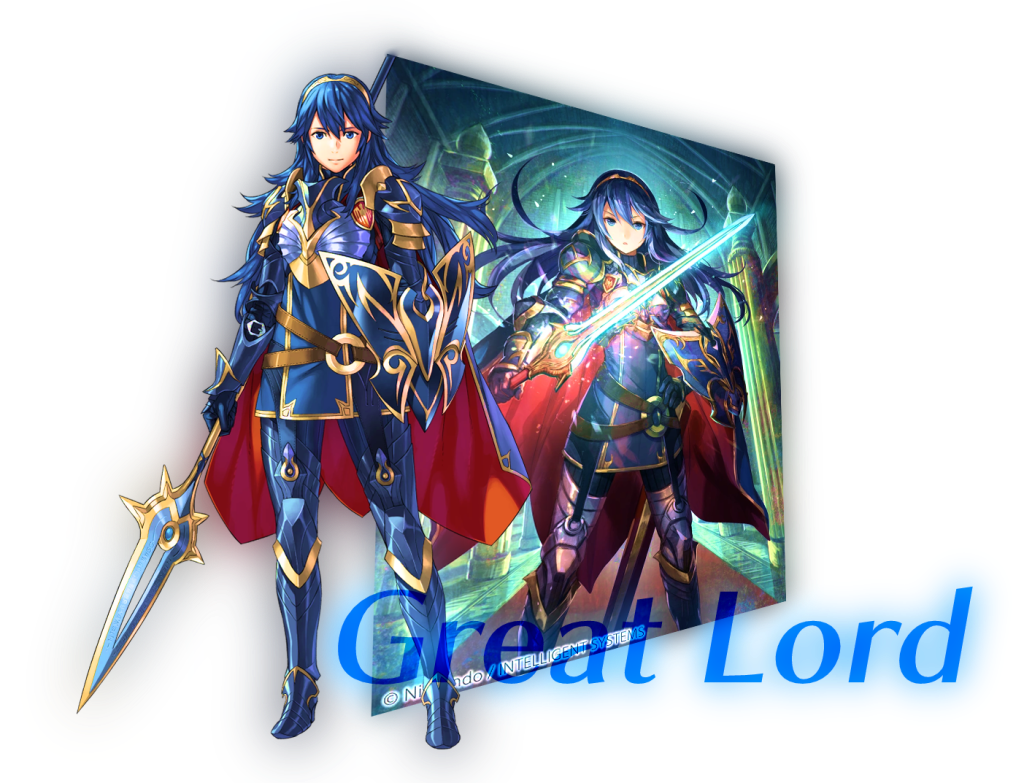
Upon using the power of a Master Seal in Fire Emblem Awakening, Lucina would achieve even greater power, becoming a Great Lord. Like the normal Lord class before it, it’s well balanced in strength, speed and defense, but raised to even a higher degree now, having more armor (and a spiffy shield!) In addition to swords, it also lets Lucina use spears and javelins, increasing her options in combat (especially since in most Fire Emblem games, spears are strong against swords). Like most Fire Emblem lords before her, it’s a powerful class and her most comfortable one.
Aside from that, in Awakening specifically, it gives her the powerful Aether skill (explained earlier, but it’s a dual hit move where the first hit heals her while the second negates enemy defense) and Rightful King, which increases the chances of activating it. It doesn’t just stop there though because thanks to the power of Lucina’s amiibo, in Fates, she gets even more skills in Dual Striker (which just lets her do more damage as a support) and the Awakening (say that again) skill, which if Lucina falls to below half her health, her hit rate and evasion are greatly increased.
Bride
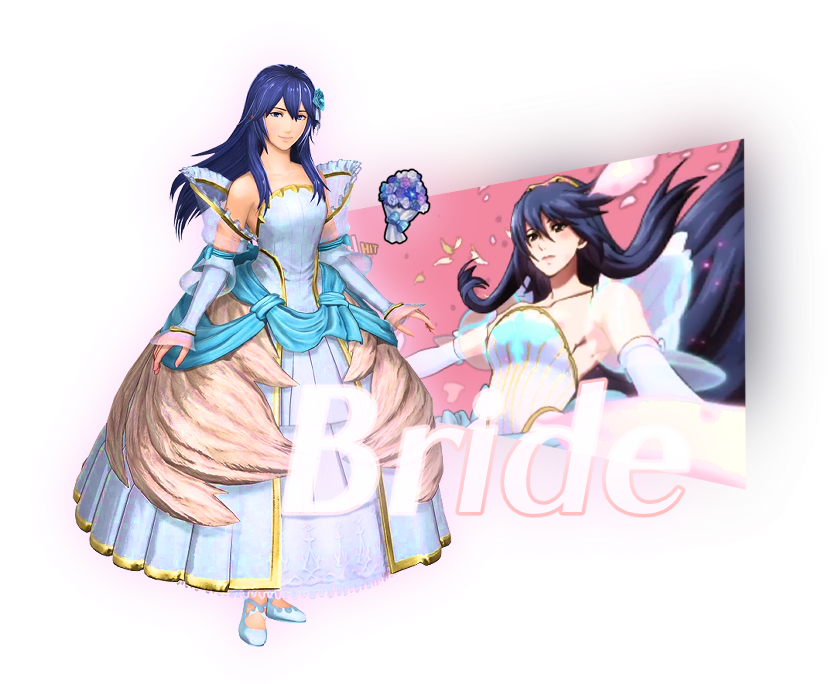
Though she may look ready to walk down the aisle, the Bride class is a genuine and legitimate Ylissean combat class, and the outfit is a formal battle dress, so Lucina can say “yes” to the dress, and is good to throw down even in the gown. Highly flexible in allowing Lucina access to Lances, Bows and Staves, she performs excellently in both offensive and supportive roles. This is further enhanced by the class’ signature skills, Rally Heart and Bond. Rally Heart provides a boost to all stats by +2, increases movement by 1, and can stack with other boosts such as Rally Spectrum and Rally Movement. Bond heals all allies within three spaces of Lucina at the start of each turn, and this skill also stacks with others like Renewal.
And although not a primary canon source, her appearance in Project X Zone 2 (another based game) shows that Lucina frequently uses the lance Gradivus, a Brave Bow, and the skill Astra while in the Bride class.
Other Classes

Classes in Fire Emblem are basically specialized fields a character can spec into, determining what library of weapons, skills, and magic they’re capable of using. Lucina can use a Second Seal to access most classes in Fire Emblem Awakening, granting her a large variety of options to choose from. Technically, she can even use Second Seals in the midst of battle, allowing her to change arsenals, acquire heavy armor, or even gain mounts entirely. These range from the armored Paladin and Great Knight to the high-flying Pegasus Knights.
And in case there’s any doubt about it, Lucina can in fact reclass even in the middle of battle. Project X Zone 2 shows what this would look like in real-time, as opposed to the turn-based presentation in mainline Fire Emblem.
- Cavalier Classes – Horseriding classes with high movement and balanced stats. Use Swords and Lances, promoting to either a Paladin or Great Knight. Great Knights also gain access to axes in their weapon set
- Archer Classes – Archers are ranged infantry units that, fittingly, use bows as their main weapon. They are promoted into either Snipers or Bow Knights. Bow Knights are mounted units that gain access to swords, but Snipers have higher accuracy and can use otherwise inaccessible bows
- Tactician/Grandmaster – Infantry class with generally balanced stats, use swords and tomes
- Knight Classes – Heavily armoured infantry, strong physical strength and high defense, but slow, with low mobility and a weakness to magic. Promote into Generals and the already mentioned Great Knight
- Myrmidon Classes – Myrmidons are infantry units exclusively focused on using swords, focusing on speed and skill, and can use some exclusive weapons. Promote into Swordmasters or Assassins. The latter gains use of Bows but loses a few unique swords
- Mercenary Classes – Mercenaries are sword wielding infantry units, promote into Heroes who can use Axes and the already covered Bow Knights
- Thief Classes – The base Thief class normally is meant more for utility than combat and are only able to use swords, though they promote into either Assassins or Tricksters, who uses swords and staves
- Mage Classes – Magic using infantry classes, weak physical defense but good resistance. Promote into either Sages or mounted Dark Knights that can use tomes and swords
- Dark Mage Classes – Infantry that make use of Dark Magic alongside regular tomes. Promote into either Sorcerers or Dark Knights
- Pegasus Knight Classes – Mounted, flying units that utilize lances and good resistance. Promote into either Falcon Knights, who gain staves or Dark Fliers that use magic
- Wyvern Rider Classes – Flying units that use axes and are more geared towards physical combat. Promote into Wyvern Lords who gain lances or Griffon Riders
- Cleric Classes – The basic Cleric class is only a defenseless healer. However, they promote into axe using War Clerics or Sages. Interestingly, certain games such as Fates have shown that healing from these kinds of healers can completely heal fatal wounds
- Troubadour Classes – Mounted healers, but are defenseless. Promote to either Valkyries, who gain tomes, or War Clerics.
Feats
Overall

- Was able to fool everyone as Marth for a while… Okay, not that long, but she tried her best!
- Actually did prevent Emmeryn’s assassination, after all (thank you, weird Spotpass paralogues!)
- Also prevented Chrom, Basilio… well, everyone’s deaths, basically
- Led the second generation of Shepherds to save an alternate future in Future Past
- In her future, was the Chosen Hero of Naga and reigning Exalt of Ylisse
- Did you know? Awakening saved Fire Emblem!
- Helped save many other worlds beyond her own, including an alternate Ylisse, the Kingdoms of Askr and Aytolis, and the continent of Elyos
- Has met Abraham Lincoln, Segata Sanshiro, and Captain Falcon
- Defeated Lon’qu, Walhart, Aversa, Yen’fay, Validar, Priam, & Grima
Power

- Like her father, casually busts down walls while training
- Craters the ground with her sword strikes
- Falchion can cleanly cut through logs
- Could directly harm and even finish off Grima, whose kinetic energy as a dragon is insane (340.4 Gigatons of TNT)
- The energy used simply to resurrect Grima created a massive shockwave and may have formed large stormclouds as a side effect
- As Emblem Lucina, one-shotted Dark Emblem Grima on Round 3
- Should be superior to the magic used by the Grimleal to induce an eruption throughout a forest
- Much stronger than a common Bolganone tome, which causes a similar but smaller eruption
- Contributed to the defeat of Velezark, who literally consumes entire dimensions (Non-Canon, see Verdict)
Speed
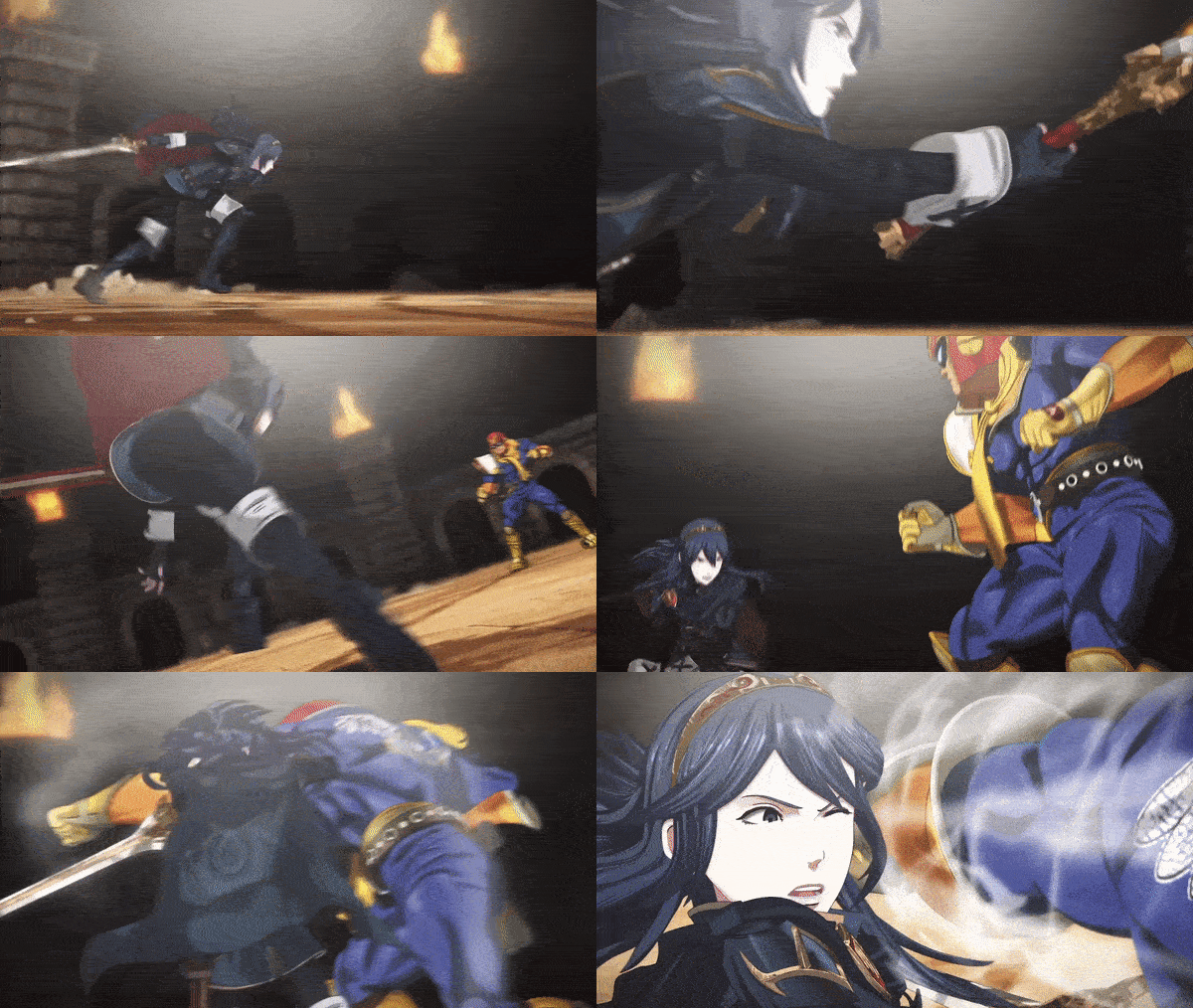
- Routinely dodges arrows and lightning with ease
- Evades a lightning strike alongside Chrom
- Threw a sword in the air, backflipped, and killed an assassin before he could swing his sword
- Moves fast enough to disappear from the view of soldiers who were looking at her
- Magic in the Archanea continuity is confirmed to harness natural elements
- While the animation is a bit questionable, the Elthunder tome in Awakening should abide by similar rules given the shared continuity, and Lucina can dodge these spells after they’re cast
- Can keep up with Pegasus Knights (or just reclass into one herself), who have been shown to fly across entire islands in a matter of seconds
- Speedblitzed Sombron’s Dark Emblem Grima in battle
Durability
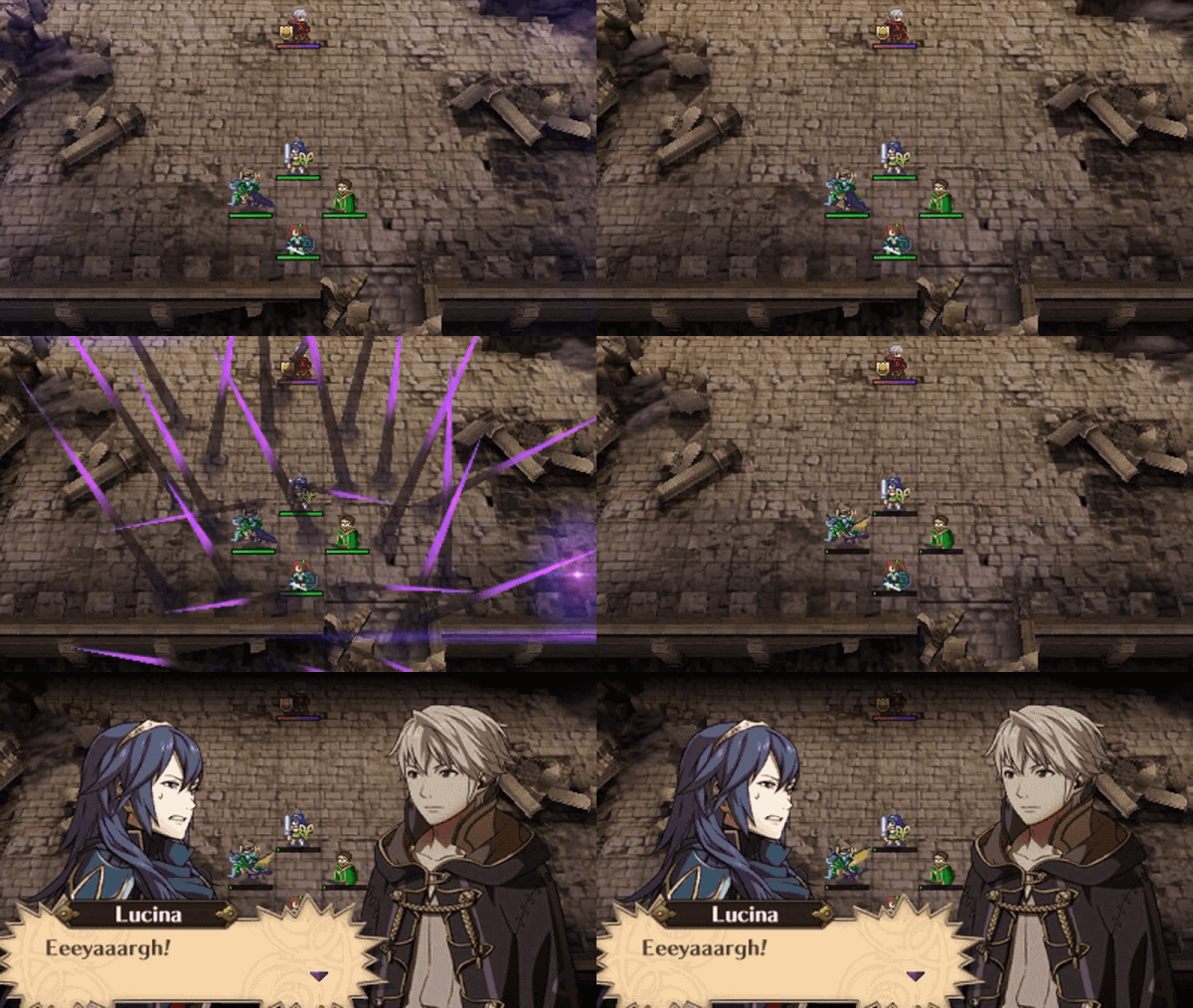
- Totally survived and fought Captain Falcon
- Survived a full-on attack from Grima
- Takes blows from Chrom on even footing
- Withstood the Awakening ritual, which involves subjecting one’s body and spirit to divine flames from Naga herself
- Can withstand attacks like Bolganone, a magic attack that involves erupting lava from beneath the earth
- Also fought unharmed inside a volcano
Scaling
The Shepherds
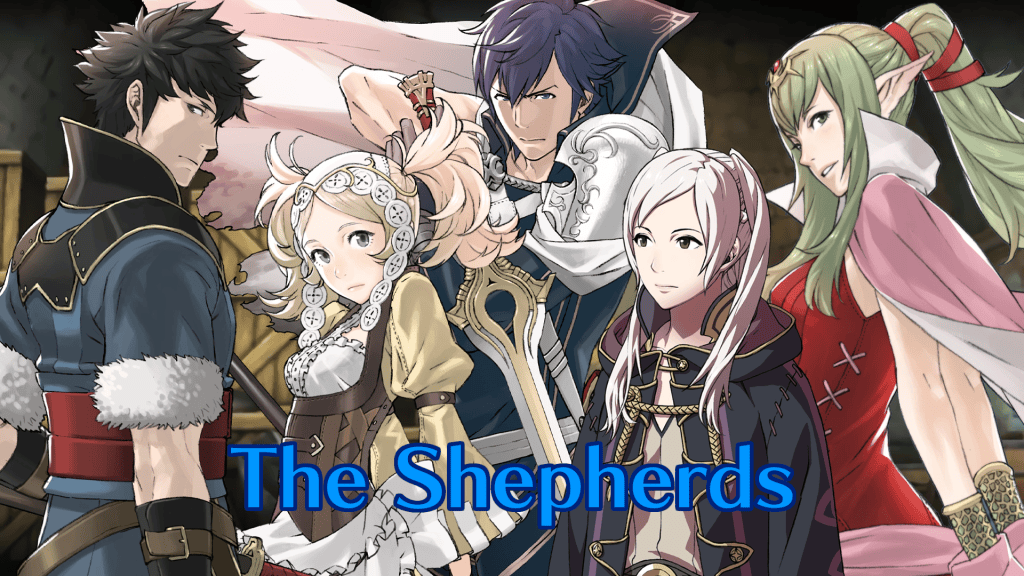
Lucina’s scaling here is mostly straightforward. She’s consistently depicted as comparable to her father, Chrom, and helps him, Robin and the rest of the army in Fire Emblem Awakening defeat Grima, the big final boss (as well as the rest of the game’s toughest enemies.)
- Chrom has the Fire Emblem (like literally inAwakening), which contains the gemstone Vert which is also just another name for the Geosphere. (Awakening takes place thousands of years after the events of Shadow Dragon and Mystery of the Emblem). The Geosphere can cause massive earthquakes that are capable of affecting a planet’s crust. (5.73 Petatons of TNT)
- Lucina also just has the Fire Emblem herself in various alternate timelines
- Yes, Fire Emblem Cipher has its own timelines and canon, it’s not just a card game
- Exalting Falchion involves channeling Naga’s power into the sword, who is the source of the Gemstone’s power
- Lucina also just has the Fire Emblem herself in various alternate timelines
- Inigo, Severa and Owain traveled to Fateslandia, directly helping in the defeat of Anankos
- Inigo in particular traded blows with Ryoma, who is far superior to the likes of Zola and Flora, who can freeze large swathes of the environment
- Ryoma can also directly use Dragon Veins, which allow the user to alter the surrounding environment through vaporization, earthquakes, concussive energy, freezing, hydrokinesis, and more
- Anankos created a black hole (16.38 Megatons of TNT)
- Anankos’ daughter (and basic enemy mob victim) Lilith created dimensions called “Star Realms”, which at the very least have a starry sky (Debatable)
- Inigo in particular traded blows with Ryoma, who is far superior to the likes of Zola and Flora, who can freeze large swathes of the environment
- Tiki directly partook in Marth’s campaign against Medeus, before later serving in the Shepherds in Chrom’s era. Lucina can of course keep up with Tiki as an equal.
- Marth’s wife Caeda flew across the island of Talys to warn Marth about the fortress attack (Mach 998.41 – 1022.62)
- Every character in Marth’s army is capable of dodging the Meteor spell, which is described as changing the trajectory of meteors scattered throughout the universe (Mach 1,079 – 2,700)
- Comparable to Navarre, who regularly moves faster than eyesight
Emblems / Einherjar

Lucina’s spirit proved strong enough to transcend her era and manifested elsewhere in the series. First as an illusory hero summoned from Mila’s Turnwheel in Shadows of Valentia, but her most prominent was becoming Emblem Lucina in Engage. Logically, Lucina would be in the same league as her fellow Emblems in service of Alear and their allies. Throughout Engage, Alear can partake in regular sparring sessions with each Emblem, and even battles some of them directly as an adversary wielded by the enemy; Lucina is one such Emblem. Once in Alear’s arsenal, Emblem Lucina can participate in battle against all other Emblems, on top of taking on the exact same foes in equal measure.
Even during her lifetime, Lucina has fought a wide range of previous Fire Emblem heavy hitters in the form of Einherjar, essentially nigh-perfect copies of the original; in Fates, the player can even create their own Einherjar, confirming that copies are 1:1 identical in stats, specifically. Given Lucina fights Einherjar of Marth, Roy, Ike, etc. after their respective stories have concluded, she’d scale to all their relevant feats and accomplishments.
We should note that both Awakening and Engage feature Einherjar and Emblems, respectively, of significant key villains throughout the series as well, which would serve to expedite certain scaling chains.
- Archanea
- Celica is much stronger than mages that can create earthquakes felt from far away (256 Megatons of TNT)
- Alm & Celica also defeated Duma, who, along with Mila, “shaped the land” of the continent Valentia
- Mila and Duma restored the land of Valentia with their dying breaths
- Celica is much stronger than mages that can create earthquakes felt from far away (256 Megatons of TNT)
- Jugdral
- Seliph and Julia defeat Julius, who is possessed by Loptous, a dark dragon equal to Naga
- Loptous shook Jugdral in his dying breaths
- Bolganone erupts lava beneath the opponent (532 Tons of TNT)
- Finn and his horse dodge lightning (Mach 108)
- Meteor during the Battle of Belhalla (15.6 Kilotons of TNT)
- Elibe
- Roy could contend with foes on the level of the Eight Legends of Elibe. As a wielder of the Binding Blade, which far surpasses the Elibean Legendary Weapons, Roy can match the power of the Ending Winter, a natural disaster that altered the weather, caused by the battle between the Legends and Dragons
- Even a much weaker Legendary Weapon, Aureola, practically acts like a nuke when used in battle (23 Kilotons of TNT)
- Niime froze all the rivers on a battlefield (1.67 Kilotons of TNT)
- Athos created several large sandstorms around Arcadia
- Raven dodges lightning (Mach 224)
- Ninian generated large ice constructs
- Magvel
- Ephraim defeated Fomortiis, who created an earthquake that shook all of Magvel while dying (74.03 Teratons of TNT)
- L’Arachel attacks with Light magic such as Ivaldi and Aura (Relativistic – 1c)
- Tellius
- Micaiah creates storm clouds when casting Rexbolt (1.4 Megatons of TNT)
- In Radiant Dawn, Ike & the Greil Mercenaries defeated Ashera, who is 1/2th of Ashunera who flooded the Earth, except for the continent of Tellius. Supplemental information confirms it was done in a “blink of an eye.” (1.5 Zettatons – 1.95 Yottatons of TNT)
- While Ike’s Ragnell was “amped” with Yune’s blessing, the blessing was to get around Ashera’s invulnerability rather than Ike needing it to match strength. It’s also Ike’s Ragnell that was blessed rather than Ike himself and he and everyone takes hits from Ashera anyway. The blessing is just a means of getting around invulnerability; this is supported by the Black Knight, whose blessed armor can only be ‘harmed’ by other blessed weapons, but does not make him immune to all damage. Backed up again by King Ashnard, who said even with the Ragnell, Ike still needed to pull his own weight and skill to defeat him.
- Also, Emblem Lucina can just defeat Dark Emblem Ashera directly anyway, lolz
- While Ike’s Ragnell was “amped” with Yune’s blessing, the blessing was to get around Ashera’s invulnerability rather than Ike needing it to match strength. It’s also Ike’s Ragnell that was blessed rather than Ike himself and he and everyone takes hits from Ashera anyway. The blessing is just a means of getting around invulnerability; this is supported by the Black Knight, whose blessed armor can only be ‘harmed’ by other blessed weapons, but does not make him immune to all damage. Backed up again by King Ashnard, who said even with the Ragnell, Ike still needed to pull his own weight and skill to defeat him.
- Fodlan
- Edelgard, Dimitri and Byleth are comparable to Rhea who destroyed and survived multiple Javelins of Light in a weakened state.
- Byleth has all the power of Sothis and all that she has discovered at the edge of time; Sothis could sink the Earth down to it’s watery depths (26.2 – 217.8 Petatons of TNT)
- In Fortunes Weave, Seteth (the same guy fromThree Houses), is comparable in speed to Dietrich. Dietrich has dodged laser/particle beams from the Salamander gun, which are explicitly confirmed to fire particle beams (0.204c)
- As Fortune’s Weave takes place before Three Houses chronologically, Emblem Byleth, Edelgard, Dimitri & Claude would inherently upscale the speed values held by Seteth. This is because Seteth grows stronger throughout the course of Fortune’s Weave before they’d meet him in Three Houses, thereby affording scaling to Dietrich’s speed feat broadly to other comparable Emblems.
- Elyos
Weaknesses
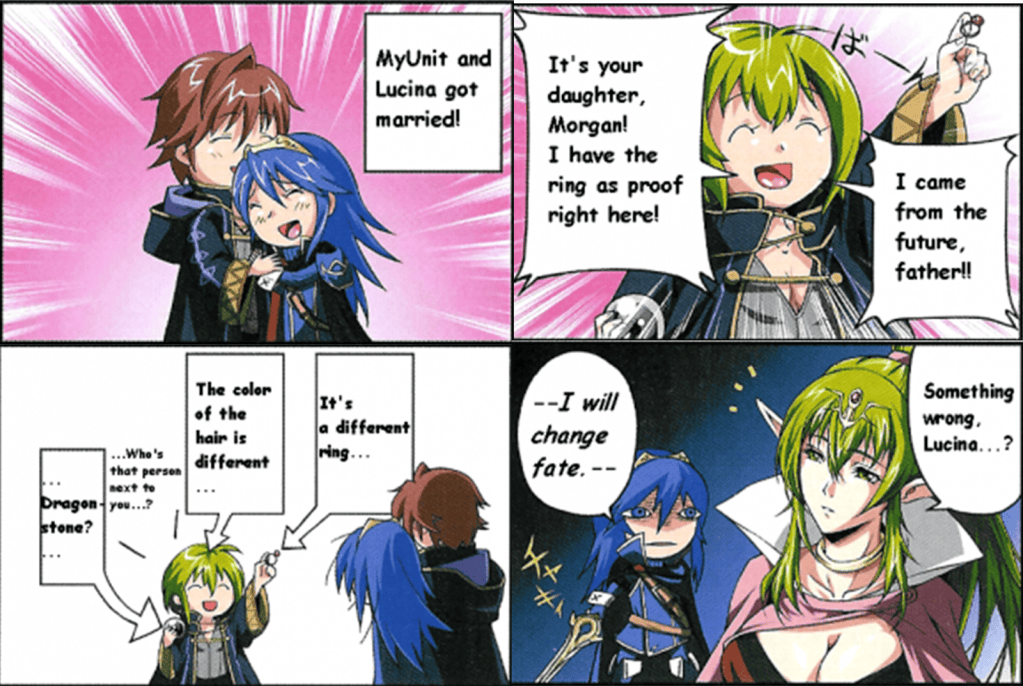
Real comic btw, source is the official Art of Fire Emblem Awakening (Knights of Iris) art book
While a skilled and powerful warrior, Lucina is not without faults. The first and most obvious is that although she is from a prolific and historied bloodline, she is as vulnerable to mortal wounds, poisons, dangerous environments, etc., as anyone. Parallel Falchion is an absolute gamechanger of a weapon, but its effectiveness lies solely at slaying dragons. So it’s super great if you have a tyrannical dragon overlord who’s messed up your future timeline, but only regularly good against everyone else. Besides Parallel Falchion, Lucina’s inventory has limits before the weapons break, run out of ammunition, or simply exhaust their magical supply.
Going by her in-game stats, Lucina is something of a glass cannon, while her offensive stats are exceptional, she has low defensive bulk, which means a comparably fast or powerful opponent could keep pace and deal significant damage to her. It’s also worth mentioning that while Lucina can change classes, these aren’t her preferred, evidently. At her maximum potential, we’d consider her to have mastered all the classes she can change into, but these wouldn’t be her starting choices, and it’d be unfeasible to expect her to cycle through them all in the course of a fight given how she’s proven to fight in canon.
It must also be mentioned that while Lucina is a massive icon and hero of many conflicts, like her forebears, her victories are not solely attributed to her. Robin’s tactical ingenuity, the collective strength of the Shepherds, etc., are major factors behind those victories. While she has more than proven herself against strong opponents in single combat, large-scale conflicts are a collaborative effort, and while she is the leader more often than not, she is not the reason those victories were achieved. Some of Lucina’s skills, like Dual Strike+ are also dependent on Lucina having an ally nearby, which Lucina won’t have in this encounter.
While Lucina has proven she can overcome great hurdles, she is still deeply defined by the complex trauma of her early life, childhood and adolescence. As such, she has both social and psychological struggles that largely define her identity, and how inseparable her identity is from the future she endeavored to change. Although these do not strictly matter in a combat scenario, she has struggled to get through these barriers to find the comfort and help she needs in her life.
Grovyle
The year is 2009, and you see an advertisement for a type of Pokémon game you had never seen before. Like any kid your age, you loved the series and its iconic creatures more than anything, and the idea of a new game would catch your interest no matter what, even if they were all kinda same-y. Soon enough, you’d find yourself with a newly unwrapped copy of the latest Pokémon spinoff: Pokémon Mystery Dungeon: Explorers of Sky.
As you boot up the game, you find it’s nothing like you expected. Personality quizzes and multiple cutscenes to start with are certainly a change of pace, and what’s this about playing as the Pokémon? It would seem you’ve entered a whole new world.
Background
- Age: Unknown
- Title: Grovyle the Thief
- Likes: Sunrises, Celebi, Through the Sea of Time, Inspirational Speeches
- Dislikes: Dialga,
Dusknoir(maybe not so much anymore), Stagnation, The color gray… basically anything about his future, really - The factually coolest middle-stage Starter Pokémon of all time
- So widely beloved that they also brought him back for Super Mystery Dungeon
The wind does not blow, water does not flow, the trees lie bare, and the sun does not move in the sky. Temporal Tower, which allows time to flow, has collapsed, and its guardian, the Dragon Pokémon Dialga, has fallen to madness, leaving the world in an eternal stasis: the Planet’s Paralysis. This Future of Darkness is all Grovyle had known for his entire life, and he was prepared to make any sacrifice in order to change it. Teaming up with a human partner with the clairvoyant ability of the Dimensional Scream and the time-travel Pokémon, Celebi, Grovyle searched the world for anything that could restore the flow of time, and he would eventually find his answer. The five Time Gears, hidden throughout the depths of the Grass Continent, had the power to stabilize Temporal Tower. With this knowledge, Grovyle and his partner entered the Passage of Time, a portal that would take them to the past, allowing them to prevent the collapse of Temporal Tower from ever occurring.
Their struggles would begin almost immediately, as they were attacked in the middle of their path through time, Grovyle’s partner taking a hit and becoming separated from him. If that wasn’t enough, his future’s Dialga did not take kindly to the idea of someone changing the past, and sent his top enforcer, Dusknoir, to hunt the duo down. Alone in a world unrecognizable to him, and with no way of tracking down his old partner, Grovyle set off alone to track down the Time Gears and find a way to the Hidden Land, where Temporal Tower stands, the sight of the sunrise reminding him of what he’s fighting for.
The tower’s collapse was already in motion, and there was no time to waste, but despite the odds so heavily being stacked against him, there was no one more suited to the task than Grovyle. His struggle to survive in the future gave him all the skills he needed to quickly track down the first Time Gear, claiming it from the heart of the remote Treeshroud Forest without a hitch, although this would cause time to stop in the region until Temporal Tower had been restored. The world would notice this disturbance, but even still, Grovyle managed to take the next Time Gear from Limestone Cavern (on the complete opposite side of the continent to the first Time Gear), and track down the third at Fogbound Lake without ever being detected.
This good fortune would not last. Although Grovyle defeated the lake spirit, Uxie, and claimed the third Time Gear, Uxie escaped and warned the world of who was responsible for stealing the Gears. To make matters worse, Dusknoir had finally made his appearance, biding his time and using his knowledge from the future to build up a reputation as a wise, renowned explorer beloved by the world. Grovyle was branded a reviled criminal, and Dusknoir rallied the support of the Pokémon of the past to have him captured, including the Pokémon of the elite Wigglytuff Guild, spinning the narrative that Grovyle was stealing Time Gears to ensure the Planet’s Paralysis.
Still, Grovyle persisted, setting out after the remaining two Time Gears, now sure to be more heavily guarded than ever. In addition to the remaining lake spirits, Grovyle would encounter a curious duo of apprentices from Wigglytuff’s Guild, somehow able to track down the Time Gears almost as well as he could. In spite of the whole world coming after him, he managed to stay a step ahead and was mere moments from claiming the final Time Gear at Crystal Lake, only to find himself in a trap that forced him to leave empty-handed. The Time Gear now inaccessible, and with no way forward, it was only a matter of time until he was captured, his quest unceremoniously brought to an end, the Time Gears taken back to their original locations, as he was dragged through a Passage of Time back to the future… alongside that odd duo of apprentices Grovyle seems to keep encountering.
The three prisoners found themselves in Dialga’s stockades, set to be executed. Grovyle wasn’t one to just lie down and die, though, and he quickly formed a plan with the apprentice duo and narrowly escaped. Now back to square one, there was only one thing for Grovyle to do: track down Celebi and make it back to the past to try again. Although reluctant at first, the duo, unsure of anything after Dusknoir’s betrayal, asked for Grovyle’s side of the story and learned what must be done to save their world. With two new unexpected allies, Grovyle reunited with Celebi and almost made it back to the Passage of Time, only for Dusknoir, joined by Dialga itself, to be lying in wait.
For once, Grovyle found himself in a situation he could see no way out of; still, his hope did not waver. His partner, that human who went to the past with him, was still out there somewhere, and they would see things through. Dusknoir had one more surprise, however, and revealed that Grovyle’s partner was not in the past, but right there, as one of the Pokémon next to him. Somehow, one of the apprentices shared the name of Grovyle’s human friend, as well as the rare Dimensional Scream ability, and their only memory was of having once been human. Realizing that this must have been caused by the attack his partner took for him back during their initial trip through time, Grovyle finally broke; it seemed like this was truly the end.
But someone else wasn’t giving up. The other apprentice, the one who had been with his old partner ever since they came to the past, demanded that Grovyle join them in a final, desperate attempt to break through and reach the Passage of Time, and it just barely worked. Grovyle was now back in the past, with one final chance at a brighter future. Quickly forming a plan, Grovyle would travel alone to collect the Time Gears again, whilst the duo would return to the Guild, spread the word of Dusknoir’s deception, and uncover the location of the Hidden Land.
With the world now behind him, and the countdown to Temporal Tower’s collapse nearing its end, Grovyle and the duo accomplished their respective quests and set out for the Hidden Land, which had been concealed in a distortion in time. After pushing through the brutal wilds of Dialga’s domain, they found themselves faced with Dusknoir, ready to make a final stand to protect his ruined future. Though he was narrowly defeated, Dusknoir had one final card to play: Grovyle lied. Grovyle knew from the very beginning that bringing the Time Gears to Temporal Tower would not save the future; it would erase it. Since the world would have never fallen to ruin in the first place, that future, alongside everyone who comes from it, would disappear to make way for a world in which life could truly thrive. Grovyle admitted to his deception, but insisted that this was a sacrifice that must be made, and his former partner agreed. Grabbing Dusknoir and heading into a Passage of Time, Grovyle bid farewell to the one who set out with him at the beginning. Although he knew they didn’t truly remember him, and that this would be the last time they’d see each other, he had full confidence that they would see things through, the other half of the apprentice duo having become a new partner for whom his old friend would gladly fight to the finish.
Finding himself back in his ruined future, all Grovyle had to do was wait until his allies saved time, and for his end to come. But Grovyle was never one to sit back and let others fight for him, and he was determined to ensure that no last-minute attempts were made to travel back to the past and interfere with the changing of history. Forming an uneasy alliance with Dusknoir, who had been abandoned by Dialga for his failure, Grovyle prepared for a final battle against the Dragon of Time. Nothing more than an attempt at stalling, but it would have to be enough.
As they traveled, they learned of Celebi’s capture by Dialga’s forces, and knew where they needed to go. Dusknoir was an unexpectedly reliable companion, even saving Grovyle at his own expense, and they began to form something of an understanding between each other. Although Grovyle could understand Dusknoir’s fear of death, he also believed that the most important thing in life is to do something that matters, and helping create a world with a bright future is something that would carry on long after he’s gone. It was seemingly too late, however, as Celebi had been bait all along; Dusknoir’s exile was a ploy to get Grovyle to let his guard down. As Grovyle’s soul melted away, his husk to be used as Dusknoir’s vessel, he made a plea to Dusknoir; he knew that the connection they formed was real, and Dusknoir knew it, too. Abandoning his plan at the last moment, Dusknoir joined with Grovyle and Celebi, the three setting out for the top of Ice Mountain, ready to stop Dialga’s final, desperate attempt to travel to the past and ensure Temporal Tower’s destruction.
Time was beginning to move again; the duo had succeeded, and as the wind started to blow and the sun rose on the horizon, Grovyle, Dusknoir, and Celebi fought against Dialga, persevering even as they began to be erased from time itself, a light enveloping them as they faded away. After a fight that took literally everything they had left, Dialga was down, and the end had finally come. After assuring Dusknoir that he made the right choice, Grovyle embraced Celebi, watching the sunrise bathing their world in color for the first time as everything vanished, Grovyle’s life shining as brightly as he had always hoped.
Then, suddenly, the light receded. Their world- Grovyle, Dusknoir, Celebi, Dialga, and all of the other Pokémon of their time were still there. It was a miracle, perhaps brought on by a power even higher than that which governs time itself. Grovyle found himself with something he never expected: a future. Now supported by the world he spent his life fighting against, Grovyle resolved to use his new life to build a home worthy of its new light. New adventures, struggles, and allies awaited him, but no one was more up to the task; Grovyle is someone who will never stop fighting.
Experience & Skill
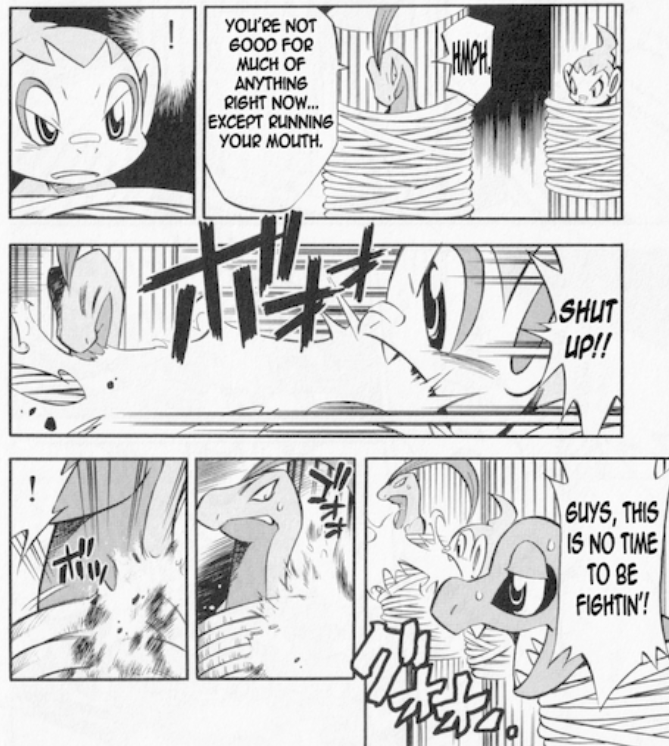
Grovyle’s combat abilities are top of the line. He has easily overwhelmed the main characters of Explorers of Sky on multiple occasions, even after they had a vision of his attack happening in the future and had plenty of time to prepare. Even Dusknoir, who’s so skilled he became a global celebrity overnight and has plenty of experience against Grovyle, often struggles to fully predict or keep track of him. Even Legendary Pokémon like Uxie, who had no trouble defeating intruders in the past, lost handily to him. It took the combined efforts of Dusknoir and every Pokémon in the world of the past to finally take him down.
Grovyle’s real skill, however, lies in exploration and survival, not surprising considering the world he had to live in. His quest to collect the Time Gears, which he starts very shortly after the beginning of the game, took him to hidden locations all across the continent that he would have had to travel on foot, and he was collecting them in a matter of days. Even the famous Wigglytuff Guild, whose jobs focus almost entirely on exploration, outlaw capture, and treasure hunting, found themselves getting outmaneuvered by Grovyle for a considerable length of time, despite them also having the aid of Dusknoir, who knew exactly what Grovyle was trying to do. Grovyle even once escaped his own execution, by quickly coming up with a plan to use a Luminous Orb as a flashbang and Dig to conceal himself and his allies, which are notably not the typical functions of either. Even after he accomplished his goal, he never stopped striving for a better world. Considering he’s still at it even in Super Mystery Dungeon, which takes place well after the rest of the series, his experience in the art of dungeon crawling is second to none (especially considering you seemingly can’t go anywhere in this world without making your way through one or two of them).
Equipment
Treasure Bag

Invaluable for any explorer, this bag stores all of the items Grovyle can use. It can hold up to 48 individual items.
Held Items
Equippable gear that grant a variety of effects. Only one can be held at a time.
- Power Band/Attack Looplet/Wildfire Looplet: Increases physical Attack.
- Special Band/Sp. Attack Looplet/Tempest Looplet: Increases Special Attack.
- Darkness Looplet: Increases Attack and Special Attack
- Defense Scarf/Defense Looplet/Radiance Looplet: Increases physical Defense.
- Zinc Scarf/Sp. Defense Looplet/Time Looplet: Increases Special Defense.
- Red Looplet: Increases Defense and Special Defense.
- Blue Looplet: Increases max HP.
- Speed Looplet/Sky Looplet: Increases speed.
- Scope Lens/Focus Looplet: Boosts Critical Hit rate.
- Choice Looplet: Increases Critical Hit rate when the same move is used multiple times in a row.
- Fickle Looplet: Increases Critical Hit rate when a different move is used from the previous turn.
- Sand Looplet: Increases the power of the wearer’s moves.
- Gold Ribbon/Gold Looplet: Useless, but worth a lot of money!
- Stamina Band: Reduces the rate at which the wearer grows hungry.
- Big Belly Looplet: Halves the rate at which the wearer becomes hungry.
- Well-Fed Looplet: Doubles the amount of hunger restored by food.
- Mist Looplet: Has a chance to prevent the wearer from using PP when using a move.
- Pecha Scarf/Pecha Looplet: Grants immunity to being Poisoned.
- Persim Band/Persim Looplet: Grants immunity to becoming Confused.
- Insomniscope/Wakeful Looplet: Grants immunity to Sleep and other related effects such as Yawning.
- Lucky Looplet: Protects the wearer from Critical Hits.
- Resilient Looplet: Prevents the wearer from having their stats lowered.
- Wind Looplet: Protects the wearer from all negative status effects and prevents their stats from being lowered.
- Munch Belt: Grants a large boost to Attack and Special Attack, but doubles the rate at which the wearer grows hungry.
- Healing Looplet: Increases natural HP regeneration.
- Heal Ribbon: Doubles natural HP regeneration, but also doubles the rate of hunger for the wearer. If held by someone other than the party leader, it will inflict the Hungry Pal status. This immobilizes the affected until they eat something.
- Tight Belt/Satitated Looplet: Totally prevents hunger, unless a Linked Move is used or the user moves through a wall.
- No-Stick Cap/Nonstick Looplet: Prevents items from becoming gunky and unusable.
- Twist Band: Prevents Attack and Special Attack from being lowered.
- Weather Band/Weather Looplet: Makes the user immune to the effects of weather.
- Prosper Looplet: Restores HP and heals status conditions when the wearer picks up money.
- Bounce Band: Causes items thrown at the wearer to bounce back in the direction they came from.
- Dodge Scarf: Causes the wearer to always avoid thrown items.
- Grass Looplet: Makes traps visible to the wearer.
- Trap Scarf/Earth Looplet: Prevents the wearer from triggering traps.
- Sneak Scarf: Allows the wearer to sneak past sleeping enemies without waking them up.
- Friend Bow: Makes the wearer 5% more likely to recruit defeated enemies.
- Amber Tear: Makes the wearer 15% more likely to recruit defeated enemies.
- Seven Treasures: A group of mythical musical instruments guarded by Legendary Pokémon that increase the recruitment rate of specific types of Pokémon by 20%.
- Aqua-Monica: Won from Kyogre, affects Water-types.Fiery Drum: Won from Heatran, affects Fire-types.Grass Cornet: Won from Mew, affects Grass-types.Icy Flute: Won from Articuno, affects Ice-types.Rock Horn: Won from Giratina, affects Rock-types.Sky Melodica: Won from Rayquaza, affects Flying-types.
- Terra Cymbal: Won from Groudon (the real one, not the illusion), affects Ground-types.
- Golden Mask: Makes the wearer 20.1% (I guess that technically makes it the best) more likely to recruit defeated enemies.
- Joy Ribbon: Grants the wearer a small amount of experience every time they take damage (although this is, as expected, useless for anyone at the level cap).
- Joy Looplet: Grants the wearer a small amount of experience over time.
- Wonder Chest: Grants the holder 20% boosted experience.
- Miracle Chest: Grants the holder 30% boosted experience.
- IQ Booster: Sometimes raises the holder’s IQ by 1 when traveling between floors of a dungeon.
- Explosive Looplet: Has a chance to cause an explosion when the user takes damage, this will damage enemies and destroy items on the ground.
- Nullify Looplet: Negates the wearer’s innate Ability.
- Lock-On Specs: Increases the accuracy of thrown items.
- No-Aim Scope: Causes items thrown by the wearer to fly in random directions.
- Whiff Specs: Causes items thrown by the wearer to always miss their target.
- X-Ray Specs/Sea Looplet: Allows the wearer to see all enemies and items on the current floor.
- Goggle Specs: Reveals invisible Pokémon, as well as hidden traps and stairs.
- Excavation Looplet: Allows the wearer to see buried items.
- Pierce Band/Water Looplet: Causes the wearer’s thrown items to travel endlessly, piercing through targets and walls (all targets hit will be subject to the item’s effects).
- Warp Scarf/Warp Looplet: Teleports the wearer to a random spot on the current floor every few steps they take.
- Unity Looplet: Causes the wearer to warp to your allies. Even if held by an enemy, this effect will bring them to you.
- Cover Looplet: The wearer will take attacks for allies that are low on HP.
- Pass Scarf/Deflect Looplet: Causes attacks made against the wearer in melee range to be passed off from the wearer and on to another Pokémon in melee range (this can be the attacker), fully deflecting any damage dealt by the attack. This effect increases the wearer’s hunger when triggered.
- Mobile Scarf: Allows the wearer to freely walk anywhere. This includes walking on water, lava, air, and through walls. However, moving across terrain in this way will rapidly increase the wearer’s hunger. Unequipping this item whilst on terrain the wearer would normally be unable to traverse will cause them to be randomly teleported to a space they are capable of walking on.
- Space Globe: The ultimate held item, doubling the base power of the holder’s moves.
Food
Single-use consumables that sate hunger (measured by the Belly stat), typically with some additional beneficial effects.
- Apple: The most basic of food items. Restores 50 Belly (out of a base 100). Slightly increases maximum belly size if eaten whilst full.
- Big Apple: Like an Apple, but bigger. Fully restores Belly, and increases maximum belly size if eaten whilst full (but a bit more than with a regular Apple).
- Huge Apple: A Really Big Apple. Simultaneously fully restores Belly and increases maximum Belly size by 10.
- Perfect Apple/Golden Apple: The ultimate varieties of Apple, certain individuals may find themselves utterly obsessed with them. Simultaneously fully restores Belly and increases maximum Belly size by 50.
- Grimy Food: Well, what were you expecting to find picking up food off the ground in a Dungeon? Restores 30 Belly, but randomly inflicts one of the following: Poisoned, Paralyzed, Burned, immobilizes the user, or lowers stats.
- Oran Berry: Heals 100 HP, can also temporarily increase the user’s maximum HP by 10.
- Cherri Berry: Heals the Paralyzed status.
- Pecha Berry: Heals the Poisoned status
- Rawst Berry: Heals the Burned status.
- Chesto Berry: Wakes up a sleeping Pokémon. If they are already awake, they will gain the Sleepless status, making them temporarily immune to Sleep and related effects.
- Sitrus Berry: Heals up to 200 HP. If used whilst HP is full, it will permanently increase max HP by a small amount.
- Elixir: Restores the PP of all of the user’s moves by 10.
- Max Elixir: Fully restores the PP of all moves.
- Ginseng: Permanently boosts the base power of the move at the top of the user’s move list by 1. Has a 12% chance to triple the effect.
- Golden Banana: Cofagrigus made it with real gold (probably)! Grants the user 5 level ups.
- Four-Leaf Cookie/Sweet Chocolate/Mega Donut: Also from Cofagrigus (no gold this time). Permanently raises a random stat by 1, with a chance of raising multiple stats by 1.
- Protein: A vitamin that permanently raises physical Attack by 1.
- Iron: A vitamin that permanently raises physical Defense by 1.
- Calcium: A vitamin that permanently raises Special Attack by 1.
- Zinc: A vitamin that permanently raises Special Defense by 1.
- Carbos: A vitamin that permanently raises Speed by 1.
- Power Drink: Permanently raises the base Power of the last move used by 2.
- Accuracy Drink: Permanently raises the base Accuracy of the last move used by 2.
- PP-Up Drink: Permanently raises the maximum PP of the last move used by 2.
- Nectar: Restores 5 PP to all moves. Can also raise IQ by 10.
- Gummies: A somewhat-rare candy that comes in 17 varieties, one for each Pokémon type (except Fairy). Eating one permanently raises a random stat, but most notably will also increase IQ. Eating the gummy that corresponds to the user’s type will have the greatest effect.
- Wonder Gummi: An extra rare flavor. Raises IQ by 15 and a random stat by 3. Also restores 50 Belly.
Seeds
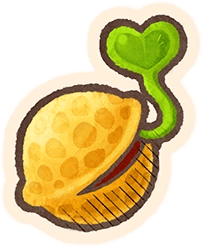
Single-use items that can either be consumed by the user, or thrown at an enemy to inflict their effects on them. These items all restore Belly by 5 in addition to their other effects.
- Blast Seed: Causes the user to breathe fire on the target in front of them, dealing 100 fixed damage. Can also be thrown, which will explode upon reaching a target, dealing 75 fixed damage.
- Sleep Seed: Inflicts the Sleep status if eaten or thrown at another Pokémon.
- Totter Seed: Inflicts the Confused status if eaten or thrown at another Pokémon.
- Stun Seed: Inflicts the Petrified status if eaten or thrown at another Pokémon.
- X-Eye Seed: Inflicts the Cross-eyed status if eaten or thrown at another Pokémon, making them unable to distinguish between allies and enemies, causing them to attack randomly.
- Blinker Seed: Inflicts the Blinker status if eaten or thrown at another Pokémon, making them unable to perceive other Pokémon or items.
- Hunger Seed: Inflicts the Hungry Pal status if eaten or thrown at another Pokémon, making them unable to move until they eat something.
- Doom Seed: Permanently lowers level by 1 if eaten or thrown at another Pokémon.
- Ban Seed: Disables the user’s most recently used move, affecting every Pokémon on the current floor.
- Vile Seed: Lowers physical Defense and Special Defense by 3 stages.
- Violent Seed: Raises physical Attack and Special Defense by 3 stages.
- Soothing Seed: Removes all stat changes, resetting both buffs and debuffs.
- Heal Seed: Removes all negative status effects and move seals on the user.
- Quick Seed: Raises Movement Speed by 1 stage.
- Eyedrop Seed: Grants the Eyedrop status, which allows the user to see hidden traps and invisible targets.
- Vanish Seed: Grants the Invisible status, which makes the user… invisible.
- Encourage Seed: Grants the Encouraged status, which causes the user’s attacks to never miss and have a boosted Critical Hit rate.
- Training Seed: Increases the user’s rate of Move Growth.
- Life Seed: Permanently increases maximum HP by a small amount.
- Joy Seed: Grants the user 1 level up.
- Golden Seed: Grants the user 5 level ups.
- Warp Seed: Teleports the user to a random spot on the current floor.
- Pure Seed: Teleports the user to the exit to the current floor.
- Decoy Seed: If held in the inventory, any effect or ability targeting the inventory will prioritize this item over all others. Inflicts the Infatuated status if eaten, causing a 50% chance for moves to fail.
- Tiny Reviver Seed: Automatically revives the user with full HP if they faint. Transforms into a Plain Seed afterwards.
- Reviver Seed: Automatically revives the user with full HP, max PP for all moves, and full Belly if they faint. Transforms into a Plain Seed afterwards.
- Plain Seed: Does nothing, but like all seeds, can be eaten to restore 5 Belly.
Wands

Items that can be waved by the user to fire a projectile that travels in a straight line until it hits a target or reaches a wall. Up to 40 uses of a wand can be stored in a single inventory space.
- Confuse Wand: Inflicts the Confused status on the target.
- Petrify Wand: Inflicts the Petrified status on the target. This fully immobilizes the target until they either take damage or the status wears off naturally.
- Slumber Wand: Inflicts the Sleep status on the target.
- Slow Wand: Reduces the target’s Movement Speed.
- Warp Wand: Teleports the target to a random space on the current floor.
- Stayaway Wand: Teleports the target in the same fashion as the Warp Wand, whilst also inflicting the Petrified status on the target.
- Whirlwind Wand: Sends the target flying backwards, causing a small amount of damage if they collide with a wall or another Pokémon.
- Switcher Wand: Teleports the user to the target’s location, whilst teleporting the target to the user’s initial location.
- Surround Wand: Teleports the user and their allies to spaces surrounding the target.
- Pounce Wand: Teleports the user and their allies to any target hit, including walls (This is actually one of the most broken items in the entire series).
- Blast Wand: Fires a projectile that explodes when it reaches a target, dealing damage to anyone nearby.
- Tunnel Wand: Destroys any walls it hits. This will deal a small amount of damage if it hits an enemy.
- Truant Wand: Changes the target’s innate Ability to Truant. This makes the target incapable of performing any moves every other turn (although the use of items is still possible). The target also has a chance to cause anyone nearby to gain the Yawning status, which turns into the Sleep status after a short period.
- HP-Swap Wand: Causes the user to swap its HP with the target’s current HP.
- Quarter Wand: Instantly reduces the target to 25% of their max HP.
- Two-Edged Wand: Instantly reduces the target to 1 HP, but halves the user’s HP in return.
Throwing Weapons
Items that can be thrown at an enemy to deal damage. These can be stacked in a single inventory space (up to either 99 or 40, depending on the game).
- Geo Pebble: Thrown in an arc, deals a fixed 10 damage.
- Gravelerock: Thrown in an arc, deals a fixed 20 damage.
- Golden Fossil: Thrown in an arc, deals a fixed 30 damage.
- Rare Fossil: Thrown in an arc, deals a fixed 100 damage.
- Wooden Spike: Thrown in a straight line, deals a small amount of damage based on physical Attack.
- Iron Thorn/Iron Spike: Thrown in a straight line, deals damage based on physical Attack. Stronger than a Wooden Spike.
- Silver Spike: Thrown in a straight line, deals damage based on physical Attack. Stronger than Iron Spikes.
- Gold Thorn/Golden Spike: Thrown in a straight line, deals damage based on physical Attack. The strongest of the Spike items.
Lookalike Items
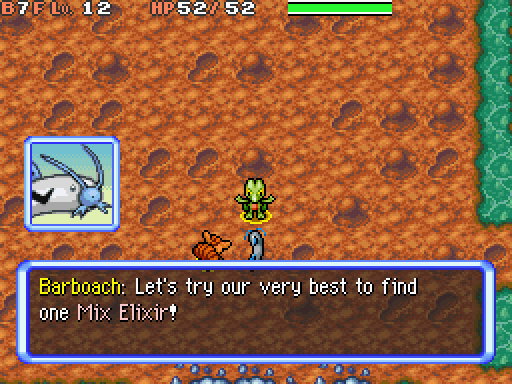
Items that closely resemble other items, but have drastically different effects. Make sure you read the names carefully!
- Oren Berry: Resembles an Oran Berry, but eating it deals 10 damage.
- Reviser Seed: Almost a Reviver Seed. Unfortunately, the minor spelling mistake will cause the user to faint from laughter immediately after being revived.
- Slip Seed: Don’t Sleep on this Seed. Eating it grants the Slip status, allowing the user to walk on water.
- Dropeye Seed: A sort of reverse Eyedrop, eating this will cause the Dropeye status, causing the user to go totally blind.
- Dough Seed: The rest of the lookalikes might have you expecting Doom, but eating this will cause piles of money to start spawning on the floor.
- Via Seed: Not as Vile as you would think. Eating this will make the user say “See-ya!” before teleporting randomly, just like a Warp Seed.
- Mix Elixir: Looks Max, but isn’t. Fully restores the PP of all moves, but is only usable by *checks notes* Linoone????
- Gone Pebble: Reminds the user of a powerful memory (perhaps of their old pet Geo Pebble?). Though the parting hurts, tears give way to resolve, and the user will gain the Endure status, making them unable to be lowered below 1 HP.
- Gravelyrock: A kind of rock candy loved by Bonsly and Sudowoodo, increasing their IQ by 10. As for everyone else? Well, it’s not as hard as a Gravelerock, but it would probably still hurt if you threw it at someone.
- Wander Gummi: If you Wonder what this does, it gunks up the user’s eyes, causing the Blinker status. This makes the user unable to perceive other Pokémon or items on the ground.
- Y-Ray Specs: Allows the wearer to see beyond mere X-Ray vision. Unfortunately, this causes the Blinker status, so you won’t be seeing much of anything. Maybe Kecleon just scammed you, actually.
- Gaggle Specs: A very noticeable pair of Goggles. Wearing these will cause enemies to focus on attacking the wearer.
- No-Slip Cap: No-Stick? No, Stick! Wearing this will cause items in the wearer’s inventory to start becoming sticky and unusable. It is unclear if this item generates dirt on its own, or if it draws it in from the surrounding environment.
…maybe you should just try throwing these at the enemy.
Orbs

Single-use items with a large variety of effects. Whilst some are single-target, most instantaneously affect the entire room, with some even being floor-wide.
Affects Environment/Terrain:
- Luminous Orb: Reveals the location of all non-invisible enemies and objects (including the exit stairs) on the current floor. Grovyle in particular has also used this item as an escape tool by using the flash of light to blind enemies.
- Radar Orb: Reveals all other Pokémon on the current floor.
- Identify Orb: Reveals all enemy Pokémon on the current floor that are holding items.
- Scanner Orb: Reveals all items on the ground on the current floor.
- Stairs Orb: Reveals the location of the exit stairs of the current floor.
- Fill-In Orb: Turns a space in front of the user from water or lava to walkable land.
- Drought Orb: Turns all water and lava on the current floor into walkable land.
- Trapper Orb: Places a random ground trap below the user.
- See-Trap Orb: Reveals all ground traps on the current floor.
- Trapbust Orb: Destroys all ground traps on the current floor.
- Trawl Orb: Pulls all items on the ground of the current floor to the user.
- Deposit Orb: Sends an item on the ground or in the user’s inventory into the user’s storage (effectively teleporting it out of the dungeon).
- Monster Orb: Creates a Monster House in the current room, which summons a large number of enemy Pokémon into the room.
- Sunny Orb: Makes the weather on the current floor Sunny, increasing the power of Fire type moves and reducing the power of Water type moves.
- Rainy Orb: Changes the weather on the current floor to Rain, increasing the power of Water type moves and reducing the power of Fire type moves.
- Sandy Orb: Changes the weather on the current floor to a Sandstorm, this periodically deals a small amount of damage to all Pokémon that are not Rock, Ground, or Steel type.
- Hail Orb: Changes the weather on the current floor to Hail, this periodically deals a small amount of damage to all Pokémon that are not Ice type.
- One-Room Orb: Destroys all walls on the current floor, turning it into a single room. This causes all room-wide effects to affect the entire floor.
- Enemy Discord Orb: Changes the Floor Status to Enemy Discord, making enemies incapable of using Alliances (essentially, coordinated attacks). Although this affects enemies exclusively, the effect is actually being applied to the dungeon floor itself, not enemies directly.
- Apathy Orb: Changes the Floor Status to Apathetic, preventing enemies from picking up items and causing them to drop whatever they are currently holding. Although this affects enemies exclusively, the effect is actually being applied to the dungeon floor itself, not enemies directly.
Single-Target (Affects User):
- Pounce Orb: Launches the user at a Pokémon or wall in their line of sight.
- Evasion Orb: Boosts the user’s Evasion by 4 stages.
- Cleanse Orb: Cleans any items in the user’s inventory that have been rendered unusable by dirt and grime.
- Longtoss Orb: Grants the user the Long Toss status, causing any item they throw to travel endlessly until they hit an object.
- Pierce Orb: Grants the user the Pierce status, causing the user’s thrown items to travel endlessly, piercing through targets and walls (all targets hit will be subject to the item’s effects). Essentially grants the same effect as the Pierce Band/Water Looplet.
- Decoy Orb: Inflicts the user or the target in front of them with the Decoy status. This will cause the affected to become preferentially targeted by all other Pokémon on the field. Additionally, moves that hit multiple enemies (this does not affect moves which damage all Pokémon indiscriminately, like Earthquake) will now only hit the Decoy.
- Rebound Orb: Grants the user the Mini Counter status, inflicting 25% of all physical damage dealt to the user back on to the attacker.
- Invisify Orb: Grants the user the Invisible status.
- Snatch Orb: Grants the user the Snatch status. This will cause the user to automatically steal any positive stat buffs used by enemies.
- Mobile Orb: Grants the user the Mobile status. This allows the wearer to freely walk anywhere. This includes walking on water, lava, air, and through walls. This is the same effect as the Mobile Scarf.
Single-Target (Affects Enemy):
- Lob Orb: Can be thrown a short distance to deal damage to a target.
- Rocky Orb: Deals damage to a target in front of the user, and reduces their Movement Speed by one stage.
- Sizebust Orb: Deals damage to a target in front of the user. The larger the target, the greater the damage.
- Mug Orb: Deals damage to a target in front of the user, stealing any item the target is holding as long as the user is not holding an item of their own.
- Blowback Orb: Causes a target in the user’s line of sight to go flying backwards, dealing slight damage if they hit a wall.
- Hurl Orb: Causes a target in front of the user to be thrown at another enemy.
- Warp Orb: Causes a target in the user’s line of sight to be teleported to a random space on the current floor.
- Stayaway Orb: Inflicts the Petrified status on a target in the user’s line of sight, then teleports the target to the exit stairs of the current floor.
- Switcher Orb: Causes a target in the user’s line of sight to swap places with the user.
- Silence Orb: Inflicts a target in front of the user with the Muzzled status, preventing any actions that require the use of their mouth.
- Shocker Orb: Inflicts a target in front of the user with the Cowering status, causing their attacks, causing them to aim attacks in the opposite direction of their target.
- One-Shot Orb: KOs a target in front of the user in a single hit, but has a high chance of missing.
- Transfer Orb: Transforms a target in front of the user into a random species of Pokémon selected from what can be found on the current floor of the dungeon. This also destroys any item the target is holding.
- Itemizer Orb: Transforms a target in front of the user into a random item, defeating them instantly. This effect is permanent and cannot be prevented by items that automatically prevent fainting, such as Reviver Seeds.
Multi-Target (Affects Allies):
- Escape Orb: Instantly teleports the user and their allies out of the current dungeon. This effect can fail in the presence of especially powerful enemies.
- Rollcall Orb: Teleports all allies to the user.
- All-Hit Orb: Grants the user and their allies the Focus Energy status, increasing their Critical Hit chance.
- All-Mach Orb: Boosts the Movement Speed of the user and their allies by one stage.
- All Dodge Orb: Boosts the Evasion of the user and their allies by four stages.
- All Power-Up Orb: Boosts the physical Attack and Special Attack of the user and their allies by four stages.
- All Protect Orb: Grants the user and their allies the Protect status, which causes all moves against the user to fail for a short time.
- Health Orb: Removes all negative status effects and stat changes to the user and their allies, and grants them the Healthy status. This prevents negative status effects and stat changes from occurring.
- Revive All Orb: Revives all allies that have fainted.
Multi-Target (Affects Enemies):
- Slow Orb: Reduces the Movement Speed of all enemies in the room by one stage.
- Petrify Orb: Inflicts the Petrified status to all enemies in the room.
- Foe-Hold Orb: Inflicts the Petrified status to all enemies on the floor.
- Lasso Orb: Pulls all enemies in the room to the user’s location and inflicts the Stuck status on them, making them incapable of movement.
- Slumber Orb: Inflicts the Sleep status to all enemies in the room.
- Totter Orb: Inflicts the Confused status to all enemies in the room.
- Foe-Fear Orb: Inflicts the Terrified status to all enemies in the room, causing them to flee.
- Foe-Seal Orb: Inflicts the Lethargic status to all enemies in the room, which causes them to stop performing any actions for a short time.
- Spurn Orb: Teleports all enemies in the room to random spaces on the floor.
- Two-Edge Orb: Reduces the HP of all enemies in the room to one, but the user’s HP will be cut in half for each enemy hit.
- Nullify Orb: Inflicts the Nullified status to all enemies on the floor, which disables their innate Abilities.
- Devolve Orb: Causes all enemies in the room to revert to their previous evolutionary stage, if applicable.
- Enemy Evolve Orb: Causes all enemies in the room to progress to their next evolutionary stage, if applicable.
Other
Exclusive Items: Rare items obtained through treasure chests found in Mystery Dungeons, or by trading with Crogunk. These items grant effects to specific types or species of Pokémon, and do not need to be held, only kept in the inventory. Multiple exclusive items can be used at once, however, multiple copies of the same item will not stack their effects.
Grass-type Exclusives:
- Grass Silk: Boosts Special Attack by 10 and Special Defense by 7.
- Grass Dust: Boosts physical Defense and Special Defense by 7.
- Grass Gem: Boosts Movement Speed by 1 in harsh sunlight.
- Soothe Globe: Negates damage from Fire type moves against the user.
Treecko evolutionary line Exclusives:
- Treeck-Thorn: Boosts physical Attack by 5.
- Treeck-Card: Boosts Special Defense by 3.
- Forest Ore: Has the effects of both the Treeck-Thorn and Treeck-Card.
- Guard Ring: Raises maximum HP by 10
- Grovy-Shoot: Boosts physical Defense by 3.
- Grovy-Card: Boosts Special Defense by 3.
- Jungle Tag: Has the effects of both the Grovy-Shoot and Grovy-Card.
- Grass Blade: 25% of the damage taken by the user from physical attacks is dealt back to the attacker.
- Scept-Claw: Boosts physical Attack by 5.
- Scept-Card: Boosts Special Defense by 3.
- Scept-Seal: Has the effects of both the Scept-Claw and Scept-Card.
- Drain Bangle: Fire type attacks against the user will heal HP instead of dealing damage.
Key: An item that can be used to unlock sealed rooms inside of dungeons.
Link Box: A single-use item that allows the user to link two of their moves together, causing them to be used together in a single turn.
Technical Machines: Typically shortened to “TMs”, these single-use items allow the user to instantly learn the move contained within the TM, assuming their species is compatible with the move. This causes it to turn into a Used TM (which in Grovyle’s case is essentially dead weight). These can be used any time, including in the middle of combat.
Abilities
Stats Explanation
- HP: Dictates a Pokémon’s maximum hitpoints. If you reach 0, you faint.
- Attack: Determines how much damage a Pokémon deals with physical moves. This generally includes anything that makes direct physical contact with an opponent, such as Grovyle’s Leaf Blade and Dig attacks.
- Defense: Determines how much damage a Pokémon takes from an opponent’s physical moves.
- Special Attack: Determines how much damage a Pokémon deals with “special” moves. This includes most ranged or energy-based attacks, such as Grovyle’s Solar Beam and Absorb.
- Special Defense: Determines how much damage a Pokémon takes from an opponent’s special moves.
- Speed: Determines accuracy. A Pokémon with higher speed will be more likely to hit their attacks and more likely to evade enemy attacks.
- Movement Speed: Determines how many actions a Pokémon can take in a single turn (which includes traveling, attacking, and using items). A Pokémon with increased Movement Speed can take multiple actions before their opponent takes one. This stat stays the same at a baseline across all Pokémon of all levels, and only changes if a move that directly affects this stat is used. Notably, changes to Movement Speed are treated as status effects, not stat changes, and are therefore not subject to abilities that remove stat buffs.
- Power Points: Typically shortened as “PP”, this is a stat attached to every move that denotes how many times it can be used. Each usage of a move consumes 1 PP.
The base stats of a Pokémon at a given level are determined by species. However, unlike the main series, in Mystery Dungeon, there is no limit to the amount of times permanent stat raising items can be used on a Pokémon (nor is there any limit on the number of these items that can be obtained). Therefore, it is possible for a Pokémon to hit the cap for every stat (500 for HP, 255 for Attack, Defense, Special Attack, Special Defense, and Speed).
Grass-Type Physiology

Grovyle is a Grass-type Pokémon, granting him a number of innate attributes. Grass-types take only half the normal damage from Water, Electric, and Ground-type attacks. Conversely, they take twice as much damage from Fire, Ice, Bug, Flying, and Poison-type attacks. Notably Grass-types are typically immune to plant-based status moves, such as Leech Seed (which attaches seeds to the target that drain health) and the various Powder moves (which spread different types of harmful plant dust on a target).
Grovyle can also benefit from Same Type Attack Bonus (or STAB), which grants him a 50% base damage multiplier on any Grass-type attack he uses.
Overgrow

Grovyle’s Ability. An Ability is something possessed by all Pokémon from birth based on their species. In other words, it is an innate biological power that works passively without any need for input or training from the user.
Overgrow causes Grovyle to receive a large boost (1.5x – 2x depending on the game) to the power of his Grass-type attacks if he is below 25% health.
Grass-Type Attacks
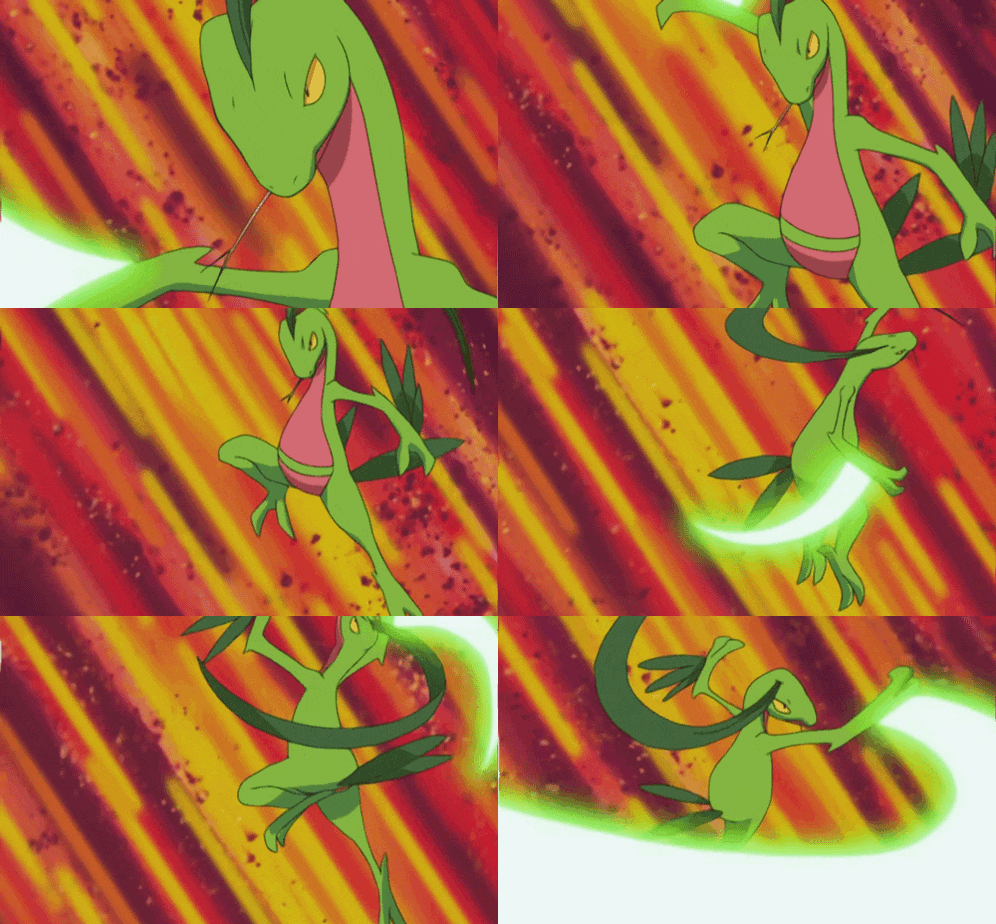
- Leaf Blade: Grovyle’s signature move, a Grass-type attack that involves slashing his target with the sharpened leaves on his arms. This move has a base 30% critical hit ratio. (Physical Attack)
- Bullet Seed: Grovyle fires a series of small Grass-type projectiles that can hit an enemy multiple times rapidly. (Physical Attack)
- Seed Bomb: A Grass-type attack in which the user fires a barrage of seeds on top of their target, which then explode. (Physical Attack)
- Absorb/Mega Drain/Giga Drain: A series of Grass-type moves of varying strength that all involve directly draining life energy from the target, healing Grovyle for 50% of the damage dealt. Notably, Absorb specifically is affected by the Muzzle status, which prevents moves that require the use of the user’s mouth. (Special Attack)
- Energy Ball: A Grass-type ranged projectile that has a chance of reducing the target’s Special Defense by one stage. (Special Attack)
- Solarbeam: A Grass-type attack that causes the user to absorb sunlight for one turn before firing the light as a beam the next turn. The beam is fired without a charge-up if used in highly sunny conditions. (Special Attack)
- Leaf Storm: A Grass-type attack that involves firing a large barrage of leaves at a target. This move is extremely powerful, but lowers the user’s Special Attack by two stages. (Special Attack)
- Grass Pledge: A Grass-type attack that fires a column of leaves at the target. If used in combination with an ally’s Water Pledge, it will create a swampy area around enemies that reduces speed. If used alongside an ally’s Fire Pledge, it will create a sea of fire around enemies, causing damage. (Special Attack)
- Grass Knot: A Grass-type attack that trips the enemy over with a snare of grass. This move deals more damage the heavier the opponent. (Special Attack)
Normal-Type Attacks

Although lacking in any specific advantages, and being ineffective against Rock, Steel, and Ghost-type opponents, Normal-type moves deal consistent neutral damage to everything else.
- Pound: A light Normal-type attack where the user simply hits the target. While in Mystery Dungeon, it is not specified, most media depicts this move as being done with legs or a tail. (Physical Attack)
- Quick Attack: A Normal-type attack in which the user dashes forward and strikes the target. This move can hit a target up to two spaces away. (Physical Attack)
- Slam: A Normal-type attack. Similar to Pound, the user strikes with their tail, although Slam does more damage at the expense of being less accurate. (Physical Attack)
- Cut: A Normal-type attack in which the user slashes with claws, dealing damage in an area around themselves. (Physical Attack)
- Facade: A Normal-type attack that increases in power (1.5x – 2x depending on the game) if the user has a negative status condition. Notably, if the status condition is a burn, this move will ignore its attack-decreasing effect. (Physical Attack)
- Frustration: A Normal-type attack that increases in power the lower the user’s IQ status or the fewer dungeons the user has explored. (Physical Attack)
- Return: A Normal-type attack that increases in power the higher the user’s IQ status or the more dungeons the user has explored. (Physical Attack)
- Strength: A Normal-type attack that can either be used to strike a target for heavy damage or grab them and throw them overhead. (Physical Attack)
- Secret Power: A Normal-type attack that draws power from the surrounding environment with a large variety of potential effects depending on the current location. (Physical Attack)
- Round: A Normal-type sound-based attack in which the user damages the target by singing. This move gets stronger if an ally uses Round alongside the user. (Special Attack)
- False Swipe: A Normal-type attack in which the user deliberately holds back, ensuring the target survives with 1 HP. (Physical Attack)
Other Attacks
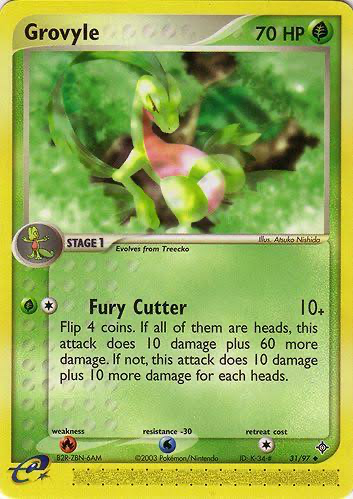
- Power-up Punch: A Fighting-type attack that, as you might expect, punches the target. This also raises the user’s physical Attack by one stage. (Physical Attack)
- Brick Break: A Fighting-type attack that involves the user striking the target with a chop. This attack will destroy psychic barriers such as Reflect and Light Screen. (Physical Attack)
- Rock Smash: A Fighting-type attack that involves the user striking the target with a punch that might lower their physical Defense. This move can destroy walls, clearing new paths to move through. (Physical Attack)
- Low Kick: A Fighting-type move that involves the user tripping the target with a kick. This move deals more damage the heavier the target is. (Physical Attack)
- Low Sweep: A Fighting-type move in which the user strikes at the target’s legs. This attack lowers the target’s Movement Speed by one stage. (Physical Attack)
- Drain Punch: A Fighting-type move that saps energy from the target, healing the user for 50% of the damage dealt. (Physical Attack)
- Focus Punch: A Fighting-type move that causes the user to begin preparing an attack for one turn. The attack will be unleashed on the second turn, dealing massive damage. This move will fail if the user takes damage whilst charging. (Physical Attack)
- Rock Tomb: A Rock-type attack that involves the user throwing boulders at the target, decreasing their Movement Speed. (Physical Attack)
- Rock Slide: A Rock-type attack that involves the user throwing a barrage of boulders at the target; this can cause the target to flinch, briefly preventing them from taking actions. (Physical Attack)
- Night Slash: A Dark-type attack in which the user slashes the target. This move has a 30% base critical hit ratio. (Physical Attack)
- Pursuit: A Dark-type move with multiple functions. It can function as an attacking move that deals 1.5x damage if the target has a status condition. It can also grant the user Counter status, which causes all physical damage dealt to the user to also be dealt to their opponent. (Physical Attack)
- X-Scissor: A Bug-type attack in which the user slashes across the target. (Physical Attack)
- Fury Cutter: A Bug-type attack in which the user slashes at the target. This move gains 1.5x power if used repeatedly. (Physical Attack)
- Aerial Ace: A Flying-type attack in which the user quickly strikes at the target. This move cannot miss under most circumstances. (Physical Attack)
- Acrobatics: A Flying-type attack in which the user strikes the target. The move deals 2x damage if the user has no held item equipped. (Physical Attack)
- Iron Tail: A Steel-type attack in which the user strikes the target with their tail. This has a chance of lowering the target’s physical Defense by one stage. (Physical Attack)
- Thunderpunch: An Electric-type attack in which the user strikes the target with an electrically charged fist. This attack has a chance of paralyzing the target, lowering their Movement Speed and preventing them from using moves. (Physical Attack)
- Dragonbreath: A Dragon-type attack in which the user unleashes a fiery projectile at the target. This attack has a chance of paralyzing the target. (Special Attack)
- Dig: A two-turn Ground-type attack in which the user spends the first turn digging a hole underground, allowing them to avoid most attacks, and then the second turn jumping out of the hole to strike the target. Grovyle has also used this move to quickly conceal himself and his allies. (Physical Attack)
- Natural Gift: An attack that involves the user drawing power from a held consumable item. The type of the attack changes depending on the consumable. This does not consume the item. (Physical Attack)
- Fling: A move that allows the user to throw an item at angles they would not normally be capable of. This move can also be used to grab an enemy and throw them at another enemy. (Physical Attack)
- Hidden Power: An attack in which the user unleashes a pulse of energy. This move’s type changes randomly every time the user enters a dungeon. (Special Attack)
- Endeavor: An attack that causes the target’s HP to become the same as the user’s current HP. (Physical Attack)
Status Moves
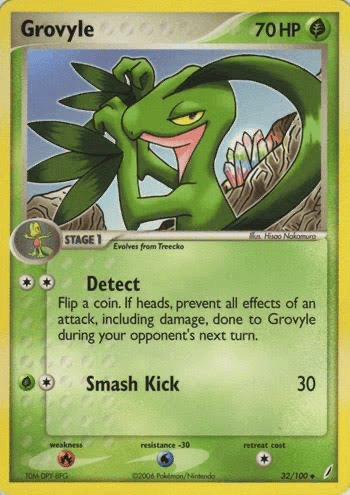
- Leer: A move in which the user intimidates the target with a leer. This lowers the target’s physical Defense by one stage.
- Screech: A move in which the user makes a harsh noise towards the target. This halves the target’s physical Defense. This effect can be stacked multiple times, reducing the target’s Defense to as low as 1/128 its normal level.
- Flash: A move in which the user blinds the target with a flash of light. This lowers the target’s accuracy by one stage.
- Confide: A move in which the user distracts their target by telling them a secret. This lowers the target’s Special Attack by one stage.
- Captivate: A move in which the user charms the target. This lowers the target’s Special Attack by two stages.
- Agility: A move that increases the Movement Speed of the user and their allies by one stage. This buff can be stacked.
- Swords Dance: A move that increases the user’s physical Attack by two stages.
- Double Team: A move in which the user creates afterimages through rapid movement. This raises the user’s Evasion by one stage.
- Toxic: A move in which the user inflicts the target with the Badly Poisoned status, which causes the target to slowly take damage over time. This also prevents the target from naturally regenerating health.
- Attract: A move in which the user causes the target to become afflicted with the Infatuation status. This creates a high chance for the target’s actions to fail.
- Swagger: A move in which the user enrages the target, increasing their physical Attack by two stages, but inflicting the Confused status. This causes the target’s movement and attacks to go in random directions, and also causes their attacking moves to hit allies, whilst their supportive moves will aid enemies.
- Worry Seed: A move in which the user plants a seed on their target that overwrites their current innate Abilities and replaces them with Insomnia, which makes them unable to sleep.
- Detect/Protect: A pair of moves that grants the user the Protect status, which causes them to avoid all incoming attacks for up to 6 turns. This status will even allow the user to avoid attacks which normally cannot miss, such as Aerial Ace. Each time these moves are used in a row gives them an increasing chance to fail. The Protect status does not avoid terrain hazards or indirect attacks, such as explosions.
- Endure: A move that grants the user the Enduring status. This causes the user to survive attacks that would otherwise KO them with 1 HP. Notably, this move shares Detect/Protect’s increasing failure chance.
- Quick Guard: A move in which the user grants itself and its allies Quick Guard status for one turn. This causes enemies’ ranged attacks to fail. Notably, this move shares Detect/Protect/Endure’s increasing failure chance.
- Safeguard: A move in which the user creates an aura around themselves and their allies that prevents them from being afflicted with negative status conditions or having their moves sealed.
- Rest: A move which causes the user to gain the Napping status. This makes the user sleep for 3-5 turns, which cannot be interrupted by damage (although moves which directly prevent sleep will still work). At the end of this period, the user will wake up, have their health fully restored and have all negative status effects and move seals removed.
- Sleep Talk: A move that can only be used whilst asleep, and will be used automatically if the user is attacked in that state. This move causes another one of the user’s moves to be selected randomly and used on their attacker.
- Snore: A Normal-type attack that can only be used when asleep. It deals damage in an area around the user and might cause enemies to flinch, briefly preventing them from taking any actions. This attack is triggered automatically if the user is attacked whilst sleeping.
If the user knows both Sleep Talk and Snore, priority will be given to whichever move is listed first in the user’s moveset.
- Substitute: A move that can either inflict the Decoy status on an enemy or grant the Substitute status to the user. The Decoy status will cause the target to become preferentially targeted by all other Pokémon on the field, both allies and enemies. Additionally, moves that hit multiple enemies (this does not affect moves which damage all Pokémon indiscriminately, like Earthquake) will now only hit the Decoy. This is the same effect as the Decoy Orb. The Substitute status sacrifices half of the user’s HP, but in turn causes them to become unable to be targeted by enemy attacks (this does not protect against moves which damage all Pokémon indiscriminately, like Earthquake). However, the Substitute can only move and can use moves or items until the status wears off naturally.
- Sunny Day: A move that changes the current weather to intense sunlight, which can be used to overwrite other weather effects. Intense sunlight increases the power of Fire-type attacks and decreases the power of Water-type attacks.
- Synthesis: A move that allows the user to restore a portion of their own HP; the specific amount depends on the weather. The default amount is 40% of the user’s max HP, but increases to 75% in intense sunlight. However, weather that decreases sunlight, such as rain, will decrease the healing to 25%
Linked Moves

Through certain means, such as a Link Box, two moves can be linked together. Moves linked in this way will be used back to back in a single turn. However, if either move runs out of PP, the moves will be delinked, even after PP is restored.
IQ Skills
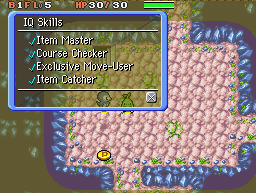
A collection of passive abilities separate from Grovyle’s moveset and innate Ability, which grant a variety of effects. These can be enabled or disabled whenever the user wishes:
- Escapist: The user can instantly teleport themselves or others out of the current dungeon using their Explorer Badge.
- Nontraitor: The user will not attack allies, even when inflicted with statuses that would normally cause them to do so, such as Confused.
- PP Saver: The user has an 8% chance to use moves without using PP.
- Self-Curer: Halves the amount of time the user needs to heal from status conditions.
- Practice Swinger: Raises the user’s Attack and Special Attack for one turn if a move misses.
- Concentrator: Raises Accuracy and reduces Evasion of the user by one stage.
- Gap Prober: The user’s thrown items will pass through allies harmlessly.
- Trap Avoider/Trap Seer: The user will not activate traps on the ground, even if they step on them.
- Sharp Shooter: Increases the user’s Critical Hit chance by 15%.
- Lava Evader: The user will avoid walking on lava (yes you actually need a skill to make the AI avoid this).
- Counter Hitter: Grants the user a 12% chance to reflect ¼ of an attack’s damage if the attacker is in melee range. This can stack with other Counter effects.
- Clutch Performer: Raises the user’s Evasion by two stages if they are under 25% HP.
- Critical Dodger: The user is immune to Critical Hits.
- Stair Sensor: The user will automatically know the location of the exit to the current floor of the dungeon.
- Extra Striker/Quick Striker: The user can perform two Regular Attacks in a row.
- Quick Dodger: The accuracy values of attacks against the user are reduced by 10%.
Resistances
- Elemental Damage: In addition to his innate resistance to Electric, Water, and Grass attacks, Grovyle’s defensive stats (primarily his Special Defense) can reduce the damage he takes from various types of elemental and esoteric attacks, such as: Fire, Dark, Ghost, Psychic, Dragon, Ice, Fairy (vaguely “magic” themed), Poison, and various light-based attacks.
Feats
Overall
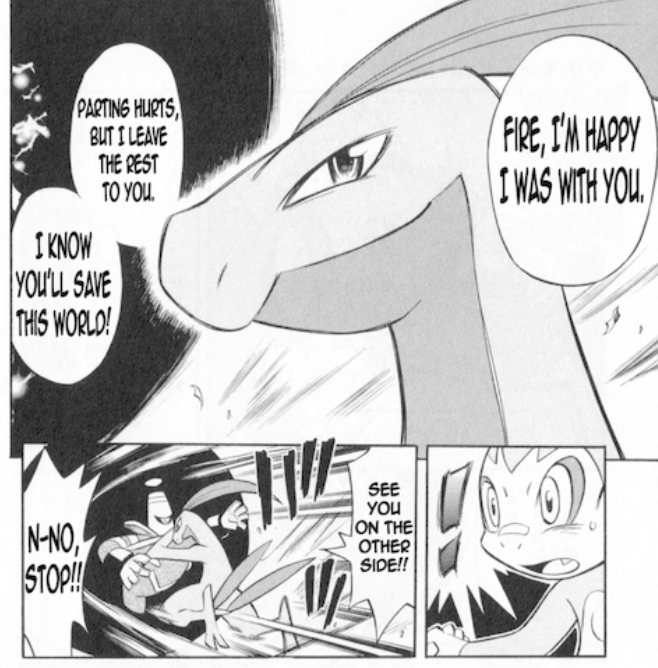
- Survived his entire life in a hostile, barren world.
- Nearly managed to complete his mission even with the whole world against him.
- Defeated Uxie, Azelf, the Explorers of Sky protagonists, Dusknoir, and Dialga.
- Convinced Dusknoir of the true value of life.
- Became by far the most popular second stage Starter Pokémon.
- Saved time from destruction and lived to keep exploring long after his story ended.
Power

- Can destroy sections of a crystal floor.
- Defeated the main duo and sent them flying with a single hit.
- Took on a horde of Sableye after fighting continuously
- Could physically restrain Dusknoir.
- And also jump super high in the air with him, god damn. Grovyle’s got hops
Speed

- Grovyle moves quickly through Treeshroud Forest.
- Grovyle vanishes mid-strike whilst fighting Dusknoir.
- In mere seconds, was able to dig three holes, bury himself and two other Pokémon, and perfectly cover them up.
- Sidestepped Dusknoir’s Shadow Ball from behind
Durability

- Endured Fury Swipes from multiple Sableye that had full intent to kill him.
- Withstood Dusknoir’s Dark Pulse.
- Takes direct hits from Dusknoir.
- Endured fighting the horde of Sableye
- Tanked the player character’s direct Flamethrower to the face
Scaling
Regular Pokémon
As one of the series’ strongest fighters, routinely keeping up with top tiers like the “superexceptional” Dusknoir, Grovyle is definitely comparable to most, if not all, explorers seen throughout the series.
- Shiftry, a fairly unremarkable explorer, cut a thundercloud in half with a gust of wind.
- At the start of his journey, Fire was strong enough to damage part of a cave.
- The Koffing he was fighting was able to cause a cave in.
- Charizard is described as having flames that can melt mountains. (579 Megatons of TNT)
- Lapras can travel across the sea quickly enough that day trips to other continents are possible.
- Dusknoir is able to intercept a lightning bolt from Manetric (Mach 1,380)
- Pokémon can use the move Draco Meteor, which calls down a… meteor. Anyone can dodge these after they’re launched (Mach 3,239 – 8,098)
- Grovyle and other Pokémon can use Solar Beam, which fires solar light.
Legendary Pokémon
Grovyle has fought his share of legends across his journey, and in Super Mystery Dungeon, he joins as a recruitable party member, so he can fight basically all of them, as they appear as post game bosses.
- Grovyle defeatedUxie, who is responsible for the illusory Groudon, which could shake the ground with its steps.
- Uxie is presumably responsible for the perpetual fog covering the area surrounding Fogbound Lake, as well as the Drought Stone, which can disperse it.
- With the help of Dusknoir and Celebi, Grovyle defeated Dialga. Dialga was able to restore life to a large section of land (yes this is the most impressive thing Dialga does in Mystery Dungeon).
- Primal Groudon appears in the post game ofSuper Mystery Dungeonas a boss.
- Groudon is stated to have created the continents. (216 Petatons of TNT)
- Mega Rayquaza also appears as a post game boss inSuper Mystery Dungeon (immediately after Dialga, funnily enough)
- Rayquaza, even in its base form, was able to destroy a world-ending meteor. (72 – 812 Teratons of TNT)
- Rayquaza on multiple occasions flies fast enough to enter space in a matter of seconds. (Mach 1,225 – 2,234)
- Yveltal is fought during the main story. Yveltal was able to create a storm which covered the planet in seconds. (78 Exatons of TNT)
Final Bosses
- The main character of Gates to Infinity defeats the Bittercold. This battle occurs prior to the postgame battle against Kyurem Black, who also appears as a postgame boss inSuper Mystery Dungeon.
- The Bittercold exerts an effect on gravity that can lift the entire Glacier Palace into the air.
- The Bittercold also holds Glacier Palace together, as it immediately collapses once the Bittercold is destroyed.
- The Bittercold is described as eating away at the heart of the world.
- Kyurem states that the Bittercold can destroy the world and create a new one (Debatable).
- The main duo of Super Mystery Dungeon defeat Dark Matter. This battle occurs prior to any of the aforementioned postgame bosses Grovyle scales to.
- Dark Matter absorbed the energy of the Tree of Life, which causes the planet to rotate. (636 Zettatons of TNT)
- The Tree of Life moves the planet away from the Sun after Dark Matter is defeated.
- Dark Matter created its own pocket dimension world.
- Dark Matter was powerful enough to pose a threat to every Pokémon on the planet, including the likes of Mewtwo, Rayquaza, and even Arceus.
- The protagonist of the WiiWare Mystery Dungeon games can defeat Arceus, who is stated to have created the world (Non-Canon, see Verdict)
- Arceus has otherwise been described as having “created everything”.
- Arceus is strongly implied to be the one who reversed the erasure of Grovyle’s future (Debatable)
Weaknesses
Although one of the greatest explorers his world has seen, Grovyle is far from invincible. Most of his innate weaknesses, namely Ice, Flying, Bug, and Poison-type attacks, are things Grovyle has no way of effectively mitigating, and he simply has to hope he can tank through double damage. He is also a product of his ruined future, where the Luminous Spring is inoperable due to the Planet’s Paralysis. As such, he couldn’t evolve into Sceptile, meaning his full evolutionary potential was something he couldn’t realise, forcing him to make the most of his potential as Grovyle. He’s also rather susceptible to being erased by time paradoxes.
Grovyle’s vast array of items and moves might seem utterly overwhelming, but they also showcase a critical limitation: Grovyle can only know 4 moves at a time, and can only carry 48 items in his inventory. This means that Grovyle cannot effectively utilize all of his potential options at once, each choice comes with opportunity cost. Bringing a Drain Bangle to negate his weakness to Fire means taking up an inventory space that may have been used on a Reviver Seed that could keep him in the fight. Bringing TMs to swap moves mid-battle means using spaces that could have been used for powerful status-inducing Orbs. This also means Grovyle needs to be careful about how he uses items, as once he runs out, he has no way of getting more besides lucking out and finding some on the ground, or just giving up and going home to grab some from storage.
Grovyle is undoubtedly extremely skilled, but it is worth noting that his greatest showings of skill and experience lie in exploration and survival rather than fighting. Whilst he has no qualms about taking on opponents he can quickly overwhelm, Grovyle consistently prefers evasion and stealth if faced with someone who can pose a threat to him, such as Dusknoir. Against an opponent who fully specializes in direct combat, Grovyle could find himself at a significant disadvantage.
Whilst Grovyle is clearly intelligent, he’s not without his blindspots. His resolve is not unbreakable, and if faced with a situation he considers unwinnable, he might actually just give up, like he did when he was cornered by Dusknoir and Primal Dialga. Despite managing to survive a hostile future, Grovyle can also be unexpectedly naive at times, such as when he trusted his longtime enemy, Dusknoir, after just a few conversations, which very nearly cost him his life (even if it worked out in the end). Although this optimism saw him through to a brighter future, it could still potentially be exploited.
Before the Verdict
Fire Emblem Cross-Scaling
This is a particularly prickly talking point for the more dedicated Fire Emblem scaling circles, so bear with us here.
As we outlined in the scaling sections above, we are affording Lucina scaling to the protagonists and feats spread across essentially the entirety of the mainline Fire Emblem entries, despite the fact that most of these take place in different continuities. This is because several games have created bridges, whether direct or inadvertent, through which we can compare the capabilities and strengths of these disparate protagonists.
First introduced in Fire Emblem Awakening, Einherjar are basically the spirits/phantoms that take the shape, personalities, and strengths of the heroes they embody. Notably, Einherjar are unaware that they are not the literal original’s flesh. Within Awakening, they’re typically summoned and made to battle through cards, and willingly act in servitude to their summoner regardless of morality conflicts.
The key thing to note here is that we are not insinuating Einherjar are the literal original versions of the characters they copy. Obviously not, that’s kinda the whole point. But just because Einherjar Ike isn’t the literal Ike doesn’t mean the copy is arbitrarily weaker; he can’t be. Fire Emblem Fates allows the player to create their own Einherjar cards using their army, and we can directly see that Einherjar take the stats of their original 1:1. Since the Einherjar Lucina fought are taken after their journeys concluded, there’s no reason to assume she’d have fought a weaker Ike or any other copy of any other hero.
This is an important precedent to set, because Intelligent Systems essentially regurgitated all of these established elements again for Fire Emblem Engage. In this game, Emblems are front and center in the narrative; Emblems are the spirits of legendary heroes throughout the Outrealms (see: multiverse) summoned through Emblem Rings. Like Einherjar, they are not the literal, original flesh and bone bodies of the heroes they embody. Unlike Einherjar, they are aware of this, but critically, they still have memories of those lives, retain their personalities, and share their combat techniques and strengths. Like Einherjar, most of the Emblems display outright knowledge up to or past the end of their original stories with one particular exception being Edelgard, Dimitri & Claude. Even if we discounted them scaling to the entirety of the feats in their games, Byleth… exists, and seems to come from a post-Verdant Wind route, so it’s a moot strike against the Three Houses scaling broadly to others.
Within the story of Engage, we witness Alear themselves become an Emblem in the climax. Surprisingly, Alear’s stats are completely identical before & after this event. Proving that Emblems are not arbitrarily thousands of times weaker or stronger than the ‘original’, regardless of it being their original body or not. Again, just like Einherjar, who carry over the stats of the original 1:1.
For these reasons, we’ve elected to afford Lucina the broad scaling derived from Emblems across the series. It’s clearly a consistent, reoccurring aspect of the series that Intelligent Systems has intended to demonstrate a degree of relativity between its protagonists. We aren’t going to get into it here, but even Fire Emblem Heroes serves as yet another entry that doesn’t exactly shy away from insinuating every game’s cast members can compete and exist in a similar weight class at their best. To argue against the notion of cross-scaling in Fire Emblem would require heavy nitpicking on minutia regarding the specifics of how these systems work to discredit literally everything else – whether it be the Einherjar’s servitude irregardless of moral restraints, or Emblems acknowledging their state as a copy, not the original – none of these take away from the fact that their strength would still be comparable to their original states, proven by the game mechanics and even the narrative of Engage.
Pokémon Mystery Dungeon
Cross-Scaling

The scaling presented here for Grovyle includes numerous points of scaling to feats in games other than that which he appeared in. Whilst the explanation is ultimately fairly straightforward, it is worth addressing here.
Pokémon Super Mystery Dungeon, unlike previous games in the Mystery Dungeon series, takes place across the entire world as opposed to a single landmass, with the various continents from previous games all appearing as locations the player can travel to. This, in effect, unified all of the Pokémon Mystery Dungeon games into a single setting. Likewise, nearly every character across the series makes an appearance in Super Mystery Dungeon, and this includes post game boss fights against nearly every Legendary Pokémon in the series, up to Generation 6 (they even get to keep their old theme music). Grovyle, as established earlier, appears as a recruitable post game playable character, who subsequently can access the storage system, shops, move tutors and any other item or system present in the game. Additionally, this also means Grovyle can be played in any mission after he is recruited, which includes all of those legendary boss fights.
Essentially, this blog is operating under the idea that this represents Grovyle’s peak, and thus he would scale to virtually every feat in the Pokémon Mystery Dungeon series, as these legendary bosses generally represent the peak of power within the setting. While there is technically no given explanation for Grovyle and Celebi’s presence in this manner, given the way their story ends in Explorers, the intent is inarguably for them to represent those characters. Frankly, Mystery Dungeon’s own internal narrative consistency has always been spotty to begin with, so it’s not an especially pertinent incongruency, all things considered.
Fan Works
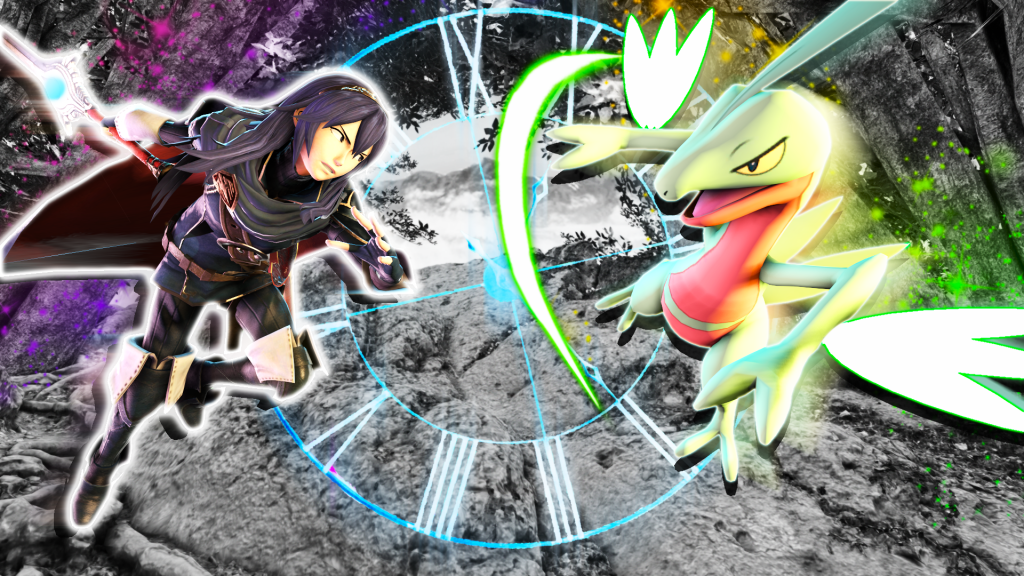
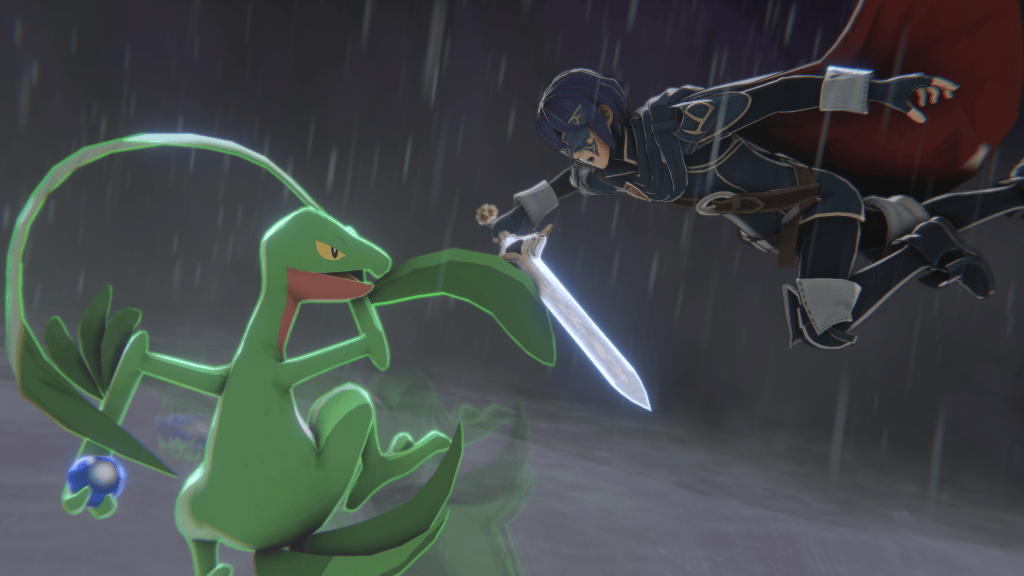
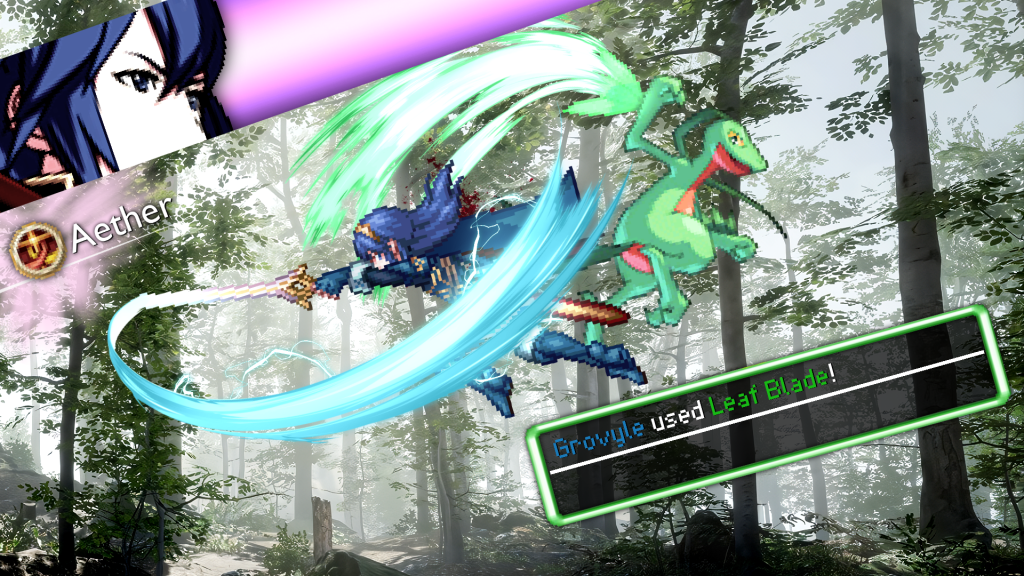
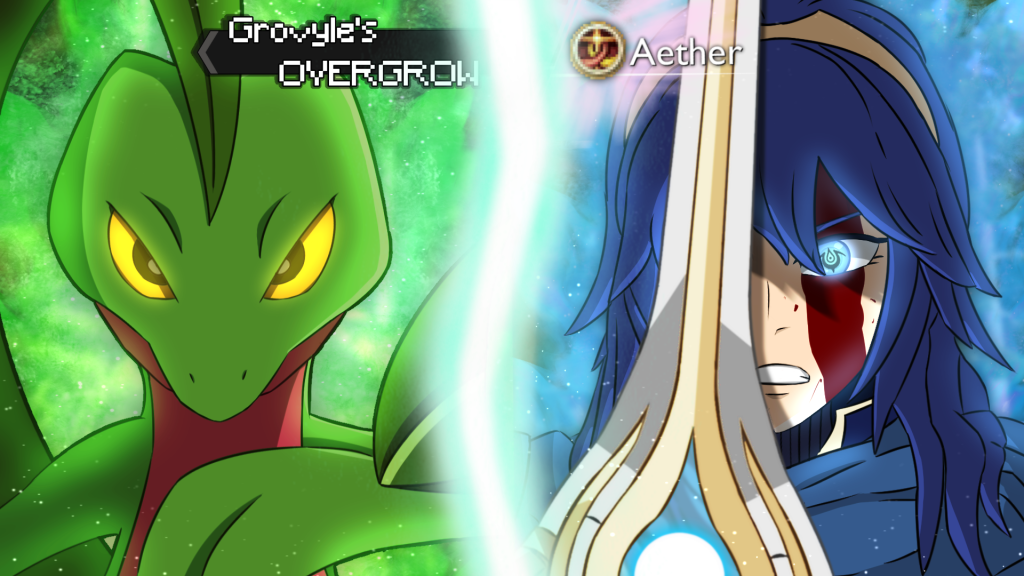
Verdict

This is a rather complex matchup with a lot to cover, so we’ve elected to break this down into three primary categories that best encapsulate the factors weighed into our verdict.
(Itching for some kickass battle music while you read? Check out any of the three – count ‘em – yes, THREE battle tracks for this matchup!)

Experience & Skill
Both Lucina and Grovyle are obviously competent fighters, skilled survivors, and have more guts than you can wave a giant hunk of iron at. However, it doesn’t take much examination to see that Lucina clearly has a more well-defined history of combat and training. Thanks to her late father’s sword lessons and the whole ‘living her entire life on the run from undead zombies sent by dragon satan who specifically wants her dead’, Lucina simply has more verifiable history and qualitative statements of skill compared to her leafy adversary.
Credit where it’s due; Grovyle has put belt to tail against the PokéPals despite the numbers disadvantage against him AND their foreknowledge of the fight beforehand. Legendary Pokémon like Uxie and Dialga have both fallen to Grovyle, either in a clean 1v1 or with some help, so it’s not like he’s devoid of impressive showings. Unlike Lucina, however, we can’t really quantify how often he trains, how rigorously, or measure him against other explicitly skilled fighters. Lucina dethroned the Regna Ferox champion swordmaster Lon’qu, for instance, and can school practiced assassins without breaking a sweat.
It shouldn’t be a huge surprise, either. Fire Emblem is a series with a multi-class system, and at her best, Lucina can re-class into several other specialized forms of combat. Swords are what she’s most comfortable with, but lances, axes, daggers, magic tomes and staves are all things she has the capacity to not just learn to use, but master the use of completely. Grovyle just doesn’t quite have the same resume on his side. Of course, skill and experience alone aren’t enough to determine who holds the edge in an up-close brawl. Let’s talk about their Strength.
Strength
In Awakening itself, Lucina has verifiably harmed Grima on her own, even with her un-awakened Parallel Falchion (per the canon Drama CD, Future of despair-recollections of a future requiem). This is backed up by, well, the game itself, where Lucina can certainly carry her weight and land some solid hits on the big G in the final battle. We’re also accounting for the full scope of Lucina’s maximum potential, which does include the Future Past timeline in which she succeeds in awakening the Falchion. So, there’s no doubt her blows with the blade would scale to the kinetic energy of Grima’s absolutely massive body thrown around; that’d clock in at about 340 Gigatons of TNT!
Sounds crazy? It’s actually just the tip of the iceberg. Remember, Awakening takes place thousands of years after Shadow Dragon and Mystery of the Emblem, Marth’s defining adventures. Marth once used the Gemstone, Vert (also known as the Geosphere) to create a massive battlefield-spanning earthquake. And mind you, these old games often spanned entire landmasses! Easy to forget, given the archaic visuals, but the lore backs this up. Given that the Geosphere’s quakes are so potent that they can even affect the planet’s crust, we can estimate Vert’s power to output just over 5 Petatons of TNT! Keep in mind, Vert is just one of several Gemstones that make up the titular Fire Emblem, a literal Binding Shield held by the wielder of Falchion. And in several alternate timelines, Lucina has acquired the very same Fire Emblem and received the very same boost in power from it.
By comparison, Grovyle’s feats in dungeon-crawling and Time Gear snatching have had him cross paths with many a chronically angry Poké-pal-in-the-making. Like Charizards, who can melt entire mountains in this universe! In order to melt a mass of granite about as large as your average mountainside based in Japan (the game’s origin of development), Charizard would need to generate heat so hot, the energy involved would nearly reach 580 Megatons of TNT!
And that Uxie that Grovyle solo’d with negative diff? It created the illusory Groudon that even the inexperienced player & partner Pokémon could take down; and they would later become allies on equal footing with Grovyle. He’d no doubt be just as capable of taking the pseudo continent-raiser down. Granted, it was only an illusory copy, rather than the real deal. Extrapolating its equivalence to the original Groudon is impossible to fully justify, but it should still be able to replicate the massive but completely casual earthquakes caused by the OG. Wouldn’t you know it, the original Groudon also shook an entire island landmass, netting an energy yield of around 46 Gigatons of TNT!
Look at that, two similar-scope earthquake feats. Why so low, you may ask? The simple answer is that the Geosphere doesn’t just induce a quake across a large area; it actively affects the crust itself. Doing so would bump the initial magnitude far higher than a more ‘standard’ earthquake, making the Geosphere far more impressive in raw potency. The difference here lies solely in the fact that Fire Emblem goes out of its way to clarify the extent of the Geosphere’s impact to greater lengths than Mystery Dungeon does for Groudon.
Both Lucina and Grovyle would upscale the value of their respective earthquakes as well, so it’s unlikely Grovyle’s superiority to Uxie would make that big of a difference compared to the combined might of several other Gemstones empowering Lucina. With this perspective, Lucina would be hundreds (586x) to hundreds of thousands of times (108,675x) stronger.
Now, let’s address the elephant in the room. Don’t these two scale a lot higher? The answer is… yes! You can consider the above values to represent a more conservative, selective outlook on scaling these characters’ respective strength values. Grima and the Geosphere both occur directly within Lucina’s home canons and timelines, without requiring scaling to entirely unrelated characters. Similarly, Charizard and the illusory Groudon don’t require justifying Grovyle scaling to completely unrelated MCs or legendaries from other Mystery Dungeon games. This is just one way to view the match, but don’t worry. We’re crossing all our T’s and dotting all our i’s for this match! Let’s talk about cross-scaling.
As we discussed more in-depth before the verdicts, we’ve deemed the feats held by other significant characters for both verses to be valid scalable quantities for both combatants here. As an Emblem, Lucina has fought in equal measure with the likes of Emblem Ike and Dark Emblem Ashera (and yes, the manga clarifies these Dark Emblems are meant to actually be the villains mentioned), so we can extrapolate the upper limits of her strength by comparing to their feats.
In the lore of Ike’s games, the goddess Ashunera once flooded the entire planet in the “blink of an eye”. We can quantify a workable timeframe, given the wording and original Japanese text, to calculate the kinetic energy of the flood Ashunera unleashed on the world. Fitting of a god of (partial) chaos, Ashunera’s flood would require nearly 2 Yottatons of TNT to pull off as described in the lore! And remember, regardless of any blessings Ike needed to keep Ashera down permanently, the rest of his team could certainly still take hits from and deal damage back to her. Emblem Lucina can even defeat the Dark Emblem Ashera in battle herself, conveniently enough.
Not to mention our boy Roy, whose Binding Blade
On the other hand, Grovyle’s appearance in Super Mystery Dungeon lets him fight on par with the newest gen protagonists, who took down Dark Matter. Not the Kirby guy, though still pretty wicked. In its mad bid to royally fuck up the planet, Dark Matter absorbed the energy of the Tree of Life, the thing responsible for the Earth’s literal rotation. The revolutionary kinetic energy of the planet, given the circumstances at the time (distance from the Sun, blah blah) would zone out at around 636 Zettatons of TNT. Giving Lucina a roughly 3x strength advantage at their respective best, scaled to the most impressive feats they can compare to.
We’ll briefly address some dodgier high-ends, giving both equal leeway and benefit of doubt, as well. If one were to posit that Dark Matter’s pocket dimension creation were legitimate, scaled to physical energy output, and contained celestial bodies within, then you could pretty reasonably match that with a similar feat in Fire Emblem: Lilith’s Star Realms. In Fire Emblem Fates, these are basically pocket dimensions with a bunch of stars in them. The creator of these spaces, Lilith, is complete cannon fodder, and the game takes place in the same direct continuity as Lucina’s, even sharing characters (the GOATed Awakening Trio). You could push both feats to similar ranges of power, but it would be worth mentioning the clear discrepancy in upscaling going on, as Lilith is quite literal basic enemy mob fodder while Dark Matter is a top tier final boss in Mystery Dungeon. Not to mention, Dark Matter creating the dimension at all is technically a mistranslation. Attributing it to them as a feat at all is rather dubious, to put it generously, whereas no such ambiguity exists with Lilith.
We can also humor the less-directly canon games, Fire Emblem Warriors and the obscure WiiWare Mystery Dungeon titles. In the former, Lucina can contribute to the defeat of Velezark, a dragon who consumes entire dimensions for breakfast… It’s literally the plot of the game! And in the WiiWare games, the player can defeat Arceus. You know, Arceus? Even in Mystery Dungeon’s isolated and stripped-down lore, it still retains clear dominance over the likes of Dialga and Palkia within Explorers’ own narrative. And that same game establishes Arceus as having created “everything”. Neither game’s feats are really consistently backed up by the mainline titles in question, but if you really wanted to push the envelope to its maximum limit, a similar story would play out as before. Lucina actually directly contributes to the battle against Velezark, and Grovyle, as far up as he’d scale by Super Mystery Dungeon, is rather hard to picture being an out-and-out equal to the literal God that bails him out at the climax of his game.
Abilities & Arsenal
To top all of that off, Lucina is bringing a considerable amount of front-loaded abilities, or Skills, to a close-range bout. Plenty of heal-on-strike options, like Aether and Sol, ensure she’ll constantly be topped up while trading hits. Luna cuts Grovyle’s defenses in half, swinging her damage output even higher on a regular basis. Pavise halves the impact of every melee hit Grovyle lands, Vantage ensures Lucina will always get the first strike in, even Lethality could snag her a one-hit kill… in theory, anyway.
By comparison, Grovyle’s items and moves can certainly keep up – he has plenty of healing options, stat alterations, and more – but most of those require his active consideration and selection to use. Lucina’s skills are, for the most part, autonomous and passive in activation, completely supplementary to her basic gameplan of getting in and hitting hard. We’ll get more into the weeds of their arsenals soon, but at close range, it’s unlikely Grovyle would even get a chance to use his wider array of options with a stronger, more skilled opponent swinging in his face.
All in all, Lucina’s strength most clearly eclipses Grovyle’s when taken under a more restrictive lens, reaching a massive hundreds of thousands-times gap. With cross scaling, that gap closes considerably, but Lucina would maintain a comfortable 3x difference in her favor. Even pushing their iffier high ends with equal fairness, Lucina simply has better feat credibility and upscaling backing her up. Either way you cut it, Lucina takes Strength. Combined with her clearly superior Experience and Skill, the Close Range is her area to dominate.

However, close range is only one part of the puzzle here. Both have plenty of tools that become truly game-changing when considered beyond the scope of a traditional melee duel, so let’s talk about their Long Range combat options.
Naturally, the first question that comes to mind when discussing distance is the Speed at which these two can control the pace of their fight. After all, whether the distance matters at all is a question that can only be answered by figuring out whose speed can control the tempo of the fight in the first place.
Speed
Sticking with our tighter, stricter evaluation of both to start, we can pretty easily gauge Lucina’s speed within the context of her own games. The Archanean games establish that magic utilizes natural elements, so those lightning bolts mages call down? Actual lightning! Lucina can easily dodge the Elthunder spell, so that’s easy lightning-fast reflexes for ya. Even better, Pegasus Knights like Caeda have flown across entire landmasses in a matter of seconds – again with the archaic visuals – which would require speeds in excess of Mach 1,000! Not only can Lucina just… reclass into a Pegasus Knight herself, she’s fought alongside the adult version of Tiki, who, as a child, was more than an equal for Caeda back in the day, too. No doubt she’d scale to this value. Oh yeah, and that same Tiki can dodge Meteors that are explicitly pulled from deep space, rather than floating around in the atmosphere. To pull space rocks that far in a manner of seconds would require the Meteor spell to launch its projectiles at nearly Mach 2,700!
On the other hand, Grovyle’s own games provide a beautifully concise and blatant feat, courtesy of our good friend and ever-trustworthy explorer, Dusknoir. He pretty blatantly intercepts a bolt of lightning after it’s fired, requiring around Mach 1,300 reaction speed! Grovyle obviously fights Dusknoir on even footing, and is certainly depicted as the nimbler, speedier of the two consistently. Even better, Grovyle himself can dodge Draco Meteor. Assuming they come from deep space, the near-nonexistent timeframe would require staggering speeds surpassing Mach 8,000! That’s how fast he’d need to be reacting to not get smacked by the giant space rocks, and he can certainly do so with ease.
Comparing their values so far, Grovyle holds a 1.3 – 3x speed advantage, primarily due to the shorter timeframe involved in the Draco Meteor animation compared to the Meteor spell. However, it is worth mentioning that only Fire Emblem goes out of its way to justify the sheer distance used in the calcs above. We are assuming rather generously that Draco Meteor similarly pulls from deep space; and frankly, you could contest both feats out of the gate for entirely unrelated reasons. Regardless of how far the meteors were pulled, they would still experience atmospheric entry, slowing them considerably and eroding their mass. That’s true for real-life meteors zooming past the cosmos, and these aren’t proven to be an exception.
Once more, we turn to cross-scaling to get a clearer picture of how they stack up at their best. This time, we turn to the latest entry in the Fire Emblem series: Fortune’s Weave. We’ll be as light on spoilers as possible, but some things concerning the broader continuity of the game are impossible to sidestep here.
For those unfamiliar, Fortune’s Weave features the groundbreaking new character we’ll lovingly refer to as Gun Nun. The game goes out of its way to clarify Gun Nun’s, well, gun, the Salamander, fires particle beams. Real-world particle accelerators can reach speeds near the speed of light; given they’re also explicitly described as lasers, it’s clear they’re meant to be the real deal. One of the main characters in Fortune’s Weave, Dietrich, blatantly reacts to and dodges these same lasers after they’re fired. That’s right, he dodged particle beams from an unhinged Karen. To do so, he’d need to be move at around 20% the Speed of Light!
How does this scale, exactly? It’s a bit roundabout, but bear with us. As a prequel to Three Houses, Fortune’s Weave features a particular character from everyone’s favorite discourse machine, er, game. A younger Seteth is present during the events of Dietrich’s story, able to fight with and against him on even footing. Not only does Seteth go on to do the same with Byleth & co. by the time of Three Houses, he’d have undoubtedly gotten stronger and faster before then. Fortune’s Weave has its own internal timeskip, and Dietrich’s feat occurs in the first half of the narrative.
In other words, by the time Edelgard, Claude and Dimitri roll around, Seteth would not only compare to Dietrich’s relativistic reaction speeds, he’d be upscaling it. As Emblems, this is the level of speed Lucina would be an equal match for, as she can keep up with and even defeat Byleth, Edelgard, Dimitri & Claude in Fire Emblem Engage.
Bada-bing bada-boom, that’s light-speed reflexes, baby! By comparison, Grovyle’s case for similar speed stems from a much simpler avenue, though there is still nuance to be had. Just like the mainline games, moves like Solar Beam, Psybeam, and Flash Cannon exist in Mystery Dungeon. If we were to assume they operate the same exact way as the main games, then it’d be fair to attribute basic light-speed values to those moves, just like Anatolia’s Salamander particle gun.
However, much like the problem that arose with Draco Meteor, we don’t actually have much of any concrete description or lore to outright confirm those attacks have light-based properties. Still, it’d be a bit obtuse to insinuate something like a Solar Beam would be anything but, so we’ll roll with that interpretation. Just like the Salamander gun, Grovyle can dodge other Pokémon using these light-speed attacks, netting vague relativistic reaction speeds. Why vague? Well, that comes down to the inherent limitation of the Mystery Dungeon games when it comes to depicting combat. Sure, attacks can miss, but measuring in-tandem movement with those animations doesn’t quite pan out how we’d like, compared to Fire Emblem.
Even so, Grovyle would certainly be faster than this value at a baseline level. Solar Beam isn’t exactly a late game attack, learnable as early as the Apple Woods! And in these games, evasion is directly tied to speed. Something like Solar Beam has a base 100 accuracy, but even that can miss if the opponent has enough of a speed gap to off-set it. However, this is not true for certain attacks like Aerial Ace, which will still land no matter the speed difference. In other words, Grovyle would scale somewhere above even relativistic values, much like Lucina would upscale the baseline relativistic speed shown by Dietrich.
Which brings us to a relative deadlock, at least as far as their maximum speed arguments go. We should stress that, internally, we’ve found Lucina’s scaling to generally be more concrete, afforded to the in-game descriptions leaving no doubt whatsoever that Fire Emblem’s lightning is legitimate, its meteors descend from deep space, and the particle cannon does fire legitimate lasers. Mystery Dungeon can match all of these, but generally require a bit of generosity in interpretation. Even so, there are no ends that would place Lucina as outright faster. There is some give and take here, but generally speaking, neither would be so fast as to blitz the other.
And this remains true when accounting for their speed-based amps, whether through items or abilities.
Arsenal
| Category | Lucina | Grovyle |
| Speed / Evasion Buffs | Outdoor Fighter | Sky Looplet |
| Prescience | Quick Seed | |
| Indoor Fighter | All-Mach Orb | |
| Avo + 10 | Agility | |
| Vantage+ | Evasion Orb | |
| Astra (Warriors) | All-Dodge Orb | |
| Patience | Double Team | |
| Lucky Seven | Detect / Protect | |
| Quick Burn | Dodge Scarf | |
| Tonics | Flash | |
| Gaius’ Confect | ||
| Tiki’s Tear | ||
| Awakening Mode | ||
| Brave Weapons | ||
| Mystletainn | ||
| Celica’s Gale | ||
| Parallel Falchion | ||
| Enemy Evasion / Accuracy Debuffs | Hex | Slow Wand |
| Anathema | Slow Orb | |
| Tantivity | Rocky Orb | |
| All Shurikens | ||
| Accuracy Boosts | Hawkeye | Lock-On Specs |
| Encourage Seed | ||
| Concentrator | ||
| Clutch Performer | ||
| Quick Dodger |
Taken holistically, Lucina has a few more options for tampering with speed, but the gap isn’t insurmountable, especially considering Grovyle can stack buffs with moves like Agility to compensate. The main difference would be that the majority of Lucina’s buffs and debuffs are passive in nature, taking effect as an aside of simply being in combat. She does not need to conscientiously choose or activate them, whereas Grovyle’s attacks and items do require consideration and selection. However, given this is the long range category, we should note that many of Lucina’s same skills that affect speed or debuff enemy stats are dependent on proximity. And if Grovyle is already far enough away to be considered at range, the drawback to needing to choose his moves over a more passive activation becomes dulled, especially if Lucina’s own abilities lessen with distance.
From there, Grovyle would be free to unload his absolutely massive arsenal of tricks and items onto the battlefield. Credit where it’s due, Lucina has quite an impressive array herself, from throwable lances and axes, lightning magic swords, the bow and arrow, shurikens and daggers, and magic tomes that can reach from afar. Even her basic melee attacks have considerable AOE in games like Fire Emblem Warriors, and, oh yeah, she can teleport!
…but that kind of pales in comparison to what Grovyle has cooking. I mean, you saw the lists earlier (unless you skimmed, in which case, shame on you)! Across all of his items, he has no less than 13 line-of-sight / projectile based Orbs, 13 room-spanning Orbs, 16 Wands, and 14 Seeds; that’s a staggering 56 relevant ranged options to choose from! And unlike Lucina’s, which mostly amount to just hitting hard no matter the flavor, be it magic or physical, Grovyle’s options are incredibly, indispensably varied, nearly every single one being a game-altering effect.
Among those 56 items, Grovyle can…
- Put Lucina to sleep with the Sleep Seed, Slumber Wand, and Slumber Orb
- Petrify or freeze her in place with the Petrify Wand, Petrify Orb, Lasso Orb or Foe-Hold Orb
- Stop Lucina from acting entirely with the Foe-Seal Orb and Truant Wand
- Inflict Confusion with the Totter Seed and Orb
- Alter Lucina’s accuracy with the X-Eye Seed
- Prevent Lucina from perceiving him at all with the Blinker Seed
- Induce fear with the Foe-Fear Orb and Shocker Orb
- Debuff her mobility with the Slow Wand, Orb, and Rocky Orb
- Displace her positioning with the Whirlwind Wand and Blowback Orb
- Disrupt Lucina’s teleportation with the Pounce Wand, Via Seed, Warp Orb, Warp Wand, Stayaway Wand, and Warp Seed
- Match Lethality’s one-shot properties with the One-Shot Orb
- Bypass Lucina’s defenses with the Quarter Wand, Two-Edged Wand and Two-Edge Orb
- Disable Lucina’s abilities with the Ban Seed
- Remove Lucina’s stat buffs with the Soothing Seed
Needless to say, while Speed is generally even, the sheer density of ranged options at Grovyle’s behest is absolutely staggering. Not only do they cover a massive range of effects that Lucina can’t anticipate, they counter several of Lucina’s key options at this distance; teleportation and her own ability to close the gap. Without question, Grovyle is the far more deadly fighter at Long Distance.
So, with Lucina being the deadlier fighter up close and Grovyle having the long range game on lock, the question becomes: who can hold out the longest in their respective disadvantaged states to turn the tides in their favor? If Grovyle can’t get away from Lucina pummeling his face in up close, it’d be GG freakin’ easy for the Exalt Princess, regardless of how many long range options he has. Likewise, it wouldn’t matter how badly Lucina throttles him up close if she can’t close the gap. The winner can only be determined by who has the greater Survivability.

This is an understated but critical field both combatants actually excel in. We touched on Lucina’s abilities briefly in the Close Range section, but her Skills like Aegis and Pavise go an incredibly long way in improving her lasting impact in a fight by halving the damage she takes across the board. In fact, she has a staggering amount of ways to heal mid-fight. Falchion, Gules / The Lifesphere, the Soothing Sword, the Sol sword, Gradivus, Hautclere, Wolt’s Bow, Nosferatu, Aversa’s Night, the Recover staff, Fruit Knife, Vulneraries, and Concoctions make up her item-based healing options. While Aether, Sol, Lifetaker, Relief, and Renewal ensure she stays topped up without needing to even try.
Combined with the Miracle skill, which can passively prevent Lucina from dying from a hit that would otherwise kill her, she becomes a juggernaut wrapped in several degrees of damage reduction, healing, and has a safety net against any fatal physical blow. This isn’t even that hard to envision; Awakening is infamous for the specific strategy of a single unit equipped to the teeth with on-hit healing to simply out-sustain entire maps of enemies!
By comparison, Grovyle’s kit leans more toward threat mitigation and complete area control to ensure his survival. Reviver Seeds kick in automatically on KO, fully healing him for another go-round. The All Protect Orb can insulate him from incoming attacks, Protect and Detect make attacks miss, and he has the Gone Pebble, which functionally acts like Lucina’s Miracle, ensuring Grovyle endures any hit (even one with a particular Lethality to it) with 1 HP. Then there’s his own array of healing options; berries, seeds, Healing Ribbons and Looplets all give him a variety of ways to top up, in addition to his natural moveset featuring moves like Absorb and Mega Drain.
Most notable, however, are Grovyle’s ways to simply avoid taking damage at all. The Pass and Dodge Scarves are… frankly, complete bullshit. With the Pass Scarf, any close-range attack launched at him will simply return to sender, no matter what manner of action it is. Physical moves, energy attacks, doesn’t matter. There is no way to bypass this effect without simply operating outside of its effective range; the Pass Scarf has no use on long-range projectiles. Which is where the Dodge Scarf comes into play, allowing Grovyle to guaranteed avoid all ‘thrown’ projectiles.These scarves do come at the cost of making Grovyle starve faster with each use, but it’s hardly a relevant drawback when he can just munch on his many berries afterward.
Lucina has no counter to these scarves. In fact, perhaps even worse than having no counter, Fire Emblem itself has a precedent for its characters getting utterly borked by abilities that nullify attacks outright. The Pass Scarf, as vague as it is in function, might as well operate in a similar manner, effectively speaking. In both cases, attacks are launched and prevented from landing because… reasons! This alone completely changes the dynamic at play here. As dominant as Lucina may be in close quarters, her skill and strength mean nothing if she can’t actually reliably land a hit on Grovyle in the area she’s supposed to hold the advantage in.
She’d need to rely on her long-ranged options – bows, magic, projectiles – but as we’ve established, half of those get negated by the Dodge Scarf, and Grovyle at range is a completely different beast than he is up close. Sure, she can technically land hits with a magic tome, but that’s hardly her go-to option, and Grovyle’s own options are barely restricted at all by Lucina’s defensive measures the same way hers are by his.
Both can mitigate critical damage, one-hit attacks and heal out the wazoo, but Lucina’s Miracle would only work if she’s above 1 HP to start. And Grovyle just so happens to have items that can cut her down to exactly 1 HP before simply landing another hit right after, such as with a thrown rock.
(Thank you, Cherry)
Not to mention, Lucina’s haxxiest option – Sealing – probably wouldn’t be a guaranteed win, either. When actually shown by Chrom against Grima in the climax of Awakening, it still required Chrom to land a physical blow on the Fell Dragon. Which, of course, would just not land against Grovyle equipped with the Pass Scarf. If you attributed Falchion’s abilities from older games and past wielders, despite Lucina never demonstrating these through her own use of the blade, its possible the Sealing could work from afar and over a wide area. But, when used against the Earth Dragons, it’s shown to moreso drag them back underground, rather than make them magically disappear. Grovyle could simply dig or teleport right back out of that, no problem.
Note: in Shadow Dragon and the Blade of Light, the Falchion technically has similar ‘sealing’ effects to the Pass Scarf, negating all physical hits from non-dragons. However, unlike the Pass Scarf, this effect is inconsistent; none of the sequels or remakes carried this effect over, and it’s certainly not present in Awakening when wielded by Chrom and Lucina. Even if you were to attribute this effect as something Lucina could benefit from, many of Grovyle’s most potent haxes wouldn’t qualify as a physical melee hit anyway, and could bypass it entirely.
Essentially, Grovyle kind of hard counters Lucina’s most relevant survival options, while his own are completely unimpeded. And that is really all it takes for the Explorer of Time and Darkness to close out the Future Witnesses’ fate here once and for all.
Conclusion

Advantages:
- Generally relative in strength or slightly stronger
- More concrete speed feats and scaling
- Frontloaded stat buffs and debuffs based on proximity
- Many skills and abilities are passive
- Tons of ways to heal mid-fight
- Miracle can clutch against potentially fatal reflected damage
- Much more clearly defined combat skill
- Greater proven combat experience
- Saved the Fire Emblem franchise
- Alexis Tipton, Laura Bailey and Yū Kobayashi
Disadvantages:
- Less versatile arsenal, even when extrapolated to the highest degree
- Far less overwhelming abilities in general
- Doesn’t stack up in cunning or tactical backfoot-planning
- Ill-equipped to withstand Grovyle’s expansive bag of tricks and haxes
- Close range advantage is completely countered by the Pass Scarf
- Still a clone in Super Smash Bros. for some reason (it’s literally part of the plot that she shares Chrom’s fighting style, she wouldn’t know how Marth fought! Sakurai caught LARPING!!!)

Advantages:
- Generally relative in strength across most ends
- Much, much more versatility through items and learned moves
- Pass Scarf completely counters a close-range encounter
- Can give Lucina debuffs she can’t shake off, such as Truant
- Generally craftier, no stranger to slippery tactics and very willing to use them
- Has several ways to critically counter Lucina’s greatest strengths
- Still the best Pokémon spin-off game, fight us!
- Dan Green
Disadvantages:
- Slightly less reliable speed scaling, though still relative
- Worse direct combat experience
- Less clearly defined combat skill
- Stat buffs are less passive, require selection and activation
- Items are technically finite in use
- New PMD any day now haha, r-right?
In this battle between Future Witness and Explorer of Time, Lucina dominates close quarters combat… in theory, thanks to her consistently superior strength, skill and experience. As a physical force, she’s incredibly difficult to get the better of through traditional brawns, but Grovyle’s strengths extend far beyond brute force. With an overwhelming arsenal with more status effects and haxes than you can shake a pointy demonspanker at, Grovyle can systemically counter nearly every significant option available to Lucina. The Pass Scarf in particular utterly denies her conventional strength and skill advantage, leaving her wide open to the sheer density of cheese in Grovyle’s arsenal to finish her off.
That said, many of Grovyle’s greatest strengths are attributed to the manner in which we elected to analyze both combatants. Under a more restricted set of standards, such as limiting both to more direct scaling chains or only allowing items or abilities they’re proven to have, it’s quite likely this would have a drastically different outcome. Nobody knows what the future holds; and that is why, just as this matchup demonstrates, the possibilities are endless.
Anyway, Lucina just got leafed behind in this timeline!
The winner is…
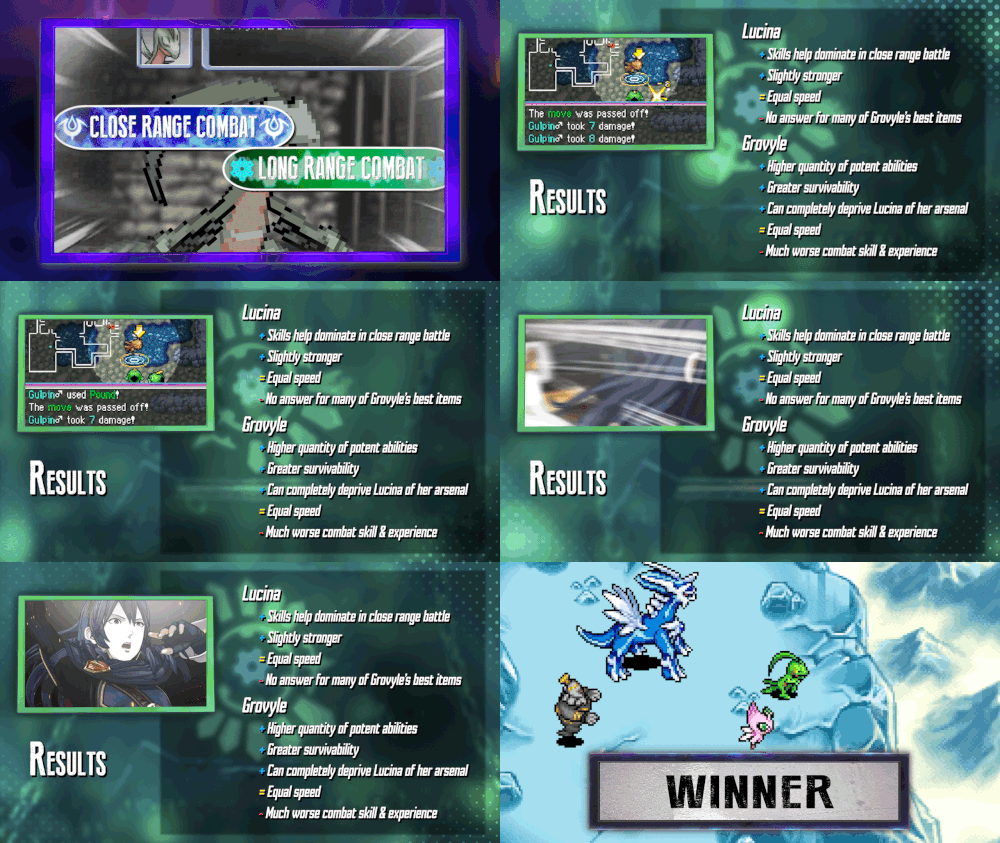
Blog Contributors: Cherry, HystericalTrend, ishi_yuki, Notatruename, Shadow7615, Soma, TWILTY
Next Time…
WAIT! Before you watch the trailer, we would like to give some context, because if you just watch the trailer you’re probably gonna be confused. Our current wave of Bonus Blogs have been (and will continue to be) released on a monthly schedule, with the next blog dropping one month from now. Over the course of the next couple days, we’ll be recruiting volunteers to work on that blog, as usual.
However, we’ve also been cooking up a storm behind the scenes, and as such have prepared three more completed blogs that we will be releasing weekly in the leadup to the next match. That is to say, the first one will release one week from now, the second two weeks, the third three weeks, and then on the fourth week, the next blog. These three additional Bonus Blogs (Bonus2 Blogs, if you will) are already done and as such require no volunteers. We hope you enjoy the additional content, in which we cover… well, that’s what the trailer is for!



Leave a Reply